
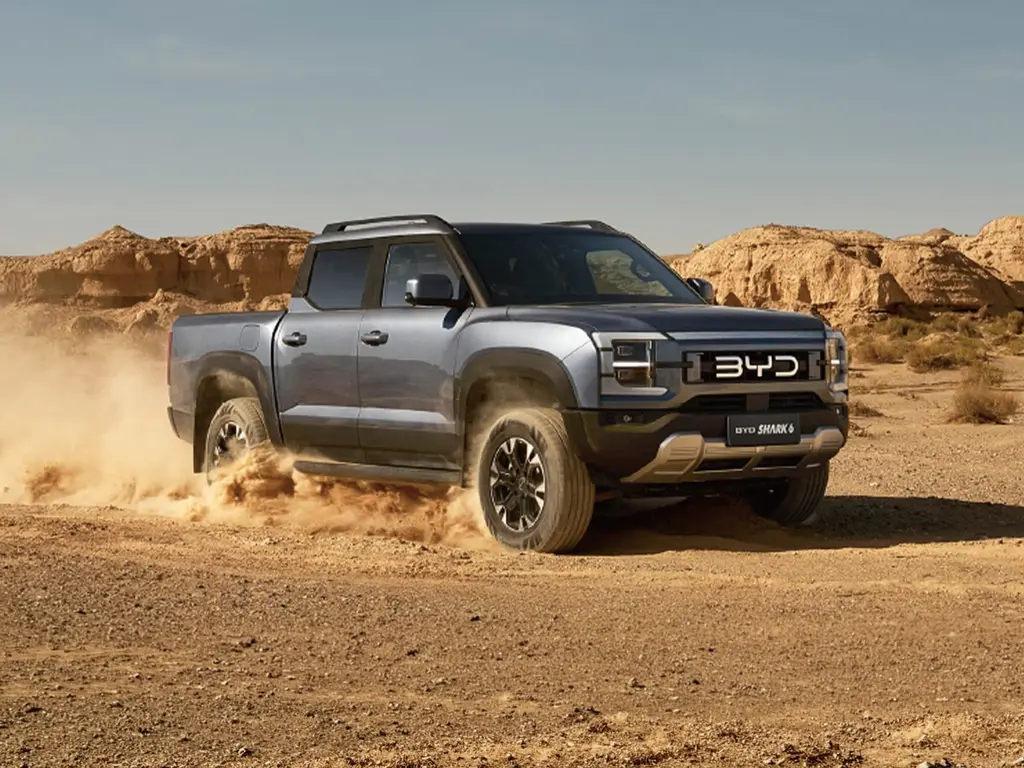
The BYD Shark 6 Performance is set to land in showrooms around the middle of the year with a bigger and more capable powertrain, combining a new 2.0-litre turbocharged petrol engine with electric motors on both axles through BYD’s Dual Mode Off-Road all-wheel-drive setup.
The updated DM Super Hybrid system in the Performance variant lifts combined output to 350 kW and 700 Nm, up from 321 kW and 650 Nm in the regular version. That extra shove translates into a 0-100 km/h sprint of 5.5 seconds, edging out the Ford Ranger Raptor, which does the same run in 5.8 seconds. Claimed efficiency sits at just 1.3 L/100 km on the WLTP combined cycle, provided the battery state of charge remains above 25 percent.
Towing is where this version really separates itself from the rest of the range. The Performance model is rated to haul up to 3,500 kg, while the Dynamic Cab-Chassis is capped at 2,500 kg. Suspension remains a double-wishbone independent setup at both ends, which has raised some questions around load handling and rear-end squat under heavy towing.
Despite being labelled an EV by some, the Shark 6 remains a hybrid with a combustion engine playing a central role. In this case, the larger 2.0-litre unit replaces the smaller 1.5-litre found in the standard model, giving it more muscle across the board.
In everyday driving, the system largely manages itself, but drivers can manually select between three operating modes depending on the situation.
EV Pure Electric Mode: The petrol engine switches off completely, leaving the electric motors to handle propulsion using stored battery energy. Ideal for urban driving, offering smooth response and zero fuel usage.
HEV Series Mode: This is the default setting for most conditions. The engine acts purely as a generator, supplying electricity to the motors that drive the wheels.
HEV Parallel Mode: Both the petrol engine and electric motors work together to power the wheels. This is useful for towing or highway cruising where additional efficiency and sustained output are required. The system also ensures the battery is continuously replenished rather than fully depleted.
A key upgrade for the latest model is the introduction of Crawl mode. The previous Mountain Mode struggled on steep terrain due to limited wheel articulation from the independent suspension setup. Crawl Mode aims to fix that by automatically managing torque delivery at low speeds, helping maintain traction over rocks, steep inclines and deep ruts. It caps speed at 20 km/h and continuously adjusts power to prevent wheel slip. If it performs anywhere near systems like Land Rover Defender Terrain Response, it could be a major improvement off-road.
Crawl Mode will come standard on the Performance variant and will also be rolled out to existing Shark 6 Premium and Dynamic models via an over-the-air update later this year.
Full specifications are still to be confirmed, but some details have emerged. The entry-level Dynamic Cab-Chassis will feature a 12.8-inch touchscreen with wireless Apple CarPlay and Android Auto. Higher-spec models, including the Premium and Performance, retain the larger 15.6-inch display along with a 10.25-inch digital instrument cluster.
Across the range, all models include 6.6 kW Vehicle-to-Load capability, multiple 230V power outlets with one inside the cabin and three in the load bed, plus an adaptor that adds two more sockets for external use.
BYD South Africa has not confirmed whether this Performance variant will be making its way to South Africa but we would be extremely surprised it it did not land on our shores in the very near future.