
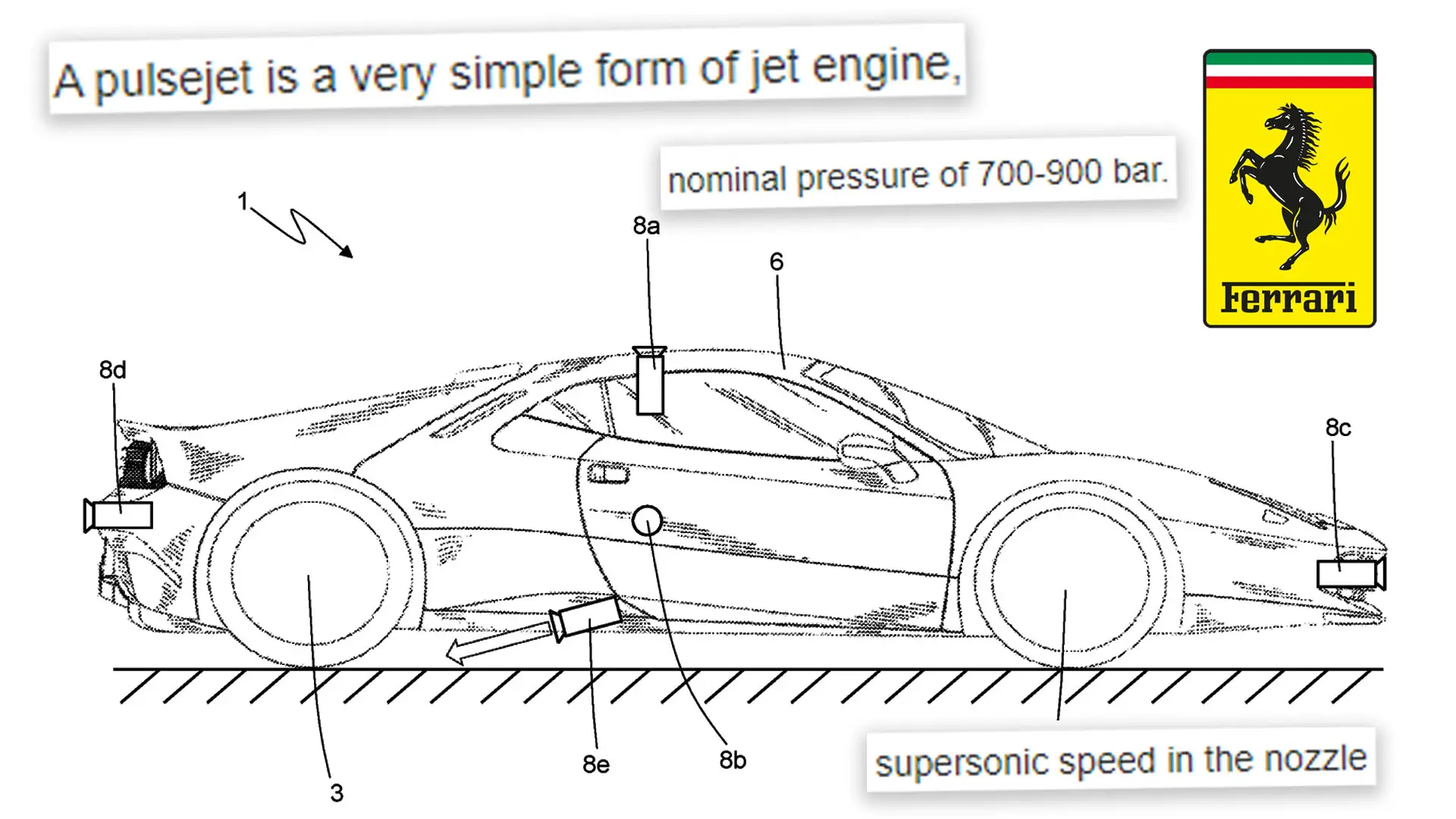
A few years ago, Elon Musk mentioned that jet thrusters could be used to take automotive performance to the next level and it was met with a lot of scepticism. Fast forward to 2023 and Ferrari has actually drawn up a system that could work.
All sports and supercar manufacturers are looking for ways to get more performance out of their creations and the latest, which comes from the folks at Maranello after coming across a patent (filed in 2019), suggests one of the answers is gas thrusters.
The folks over at TheDrive have explained it superbly well so take a read below.
Ferrari’s system does not work like a compressed air gun you might’ve used before. Each thruster location, of which there would be a “plurality,” contains multiple nozzles. Ferrari’s documentation describes five nozzles per thruster location, each with a progressively larger orifice. The idea is that when the tank is full and the pressure is high, a small orifice can be used to get the required force, which Ferrari estimates to be around 5,000 newtons. When the tank is emptier and pressure is lower, the system switches to a larger diameter nozzle to deliver the same force, albeit with a shorter impulse. In this way, a consistent push can be achieved for a longer period of time. It’s worth mentioning that all of this flow would be supersonic and extremely loud.
The whole system, which Ferrari estimates would add just “40-45 kg” in weight, is far more sophisticated than what Elon Musk has described on Twitter. This is a patent application, after all. The thrusters are not just used to add downforce and make the car accelerate and decelerate quicker. They do that, to be clear, but they also create aerodynamic downforce by flowing large volumes of air between the vehicle’s floor and the road, which not only accelerates the car but produces downforce via the ground effect—the venturi effect—as well. It would sort of work like a fan car but without a fan.
Tesla’s proposed system has been described by Musk as moving air with an electric compressor. Ferrari’s system does not do that. In one description, it uses a compressor that is mated mechanically to the front or rear axle working in concert with a heat exchanger to keep the air density as high as possible. This system allows the compressor to effectively be used as a kinetic energy recovery system. Energy from braking would be used to compress air which could be used again to accelerate the car, increase cornering speeds, etc. Wacky. Alternatively, an external filling system could also be used, although this would limit the system’s effectiveness.
Ferrari’s patent app comes to a close soon after describing all of this, but not before mentioning something Tesla is less likely to pursue. I’ll just let the patent speak for itself here. “According to a different possible embodiment, the gas pushers do not operate through compressed air… but are pulsejets, which are supplied with a liquid fuel (typically, the same liquid fuel supplying [the] internal combustion heat engine.)” In other words: no compressed air, no problem. Ferrari will just use gasoline pulsejets to create the necessary force.
The Drive
Will this ever see the light of day?