
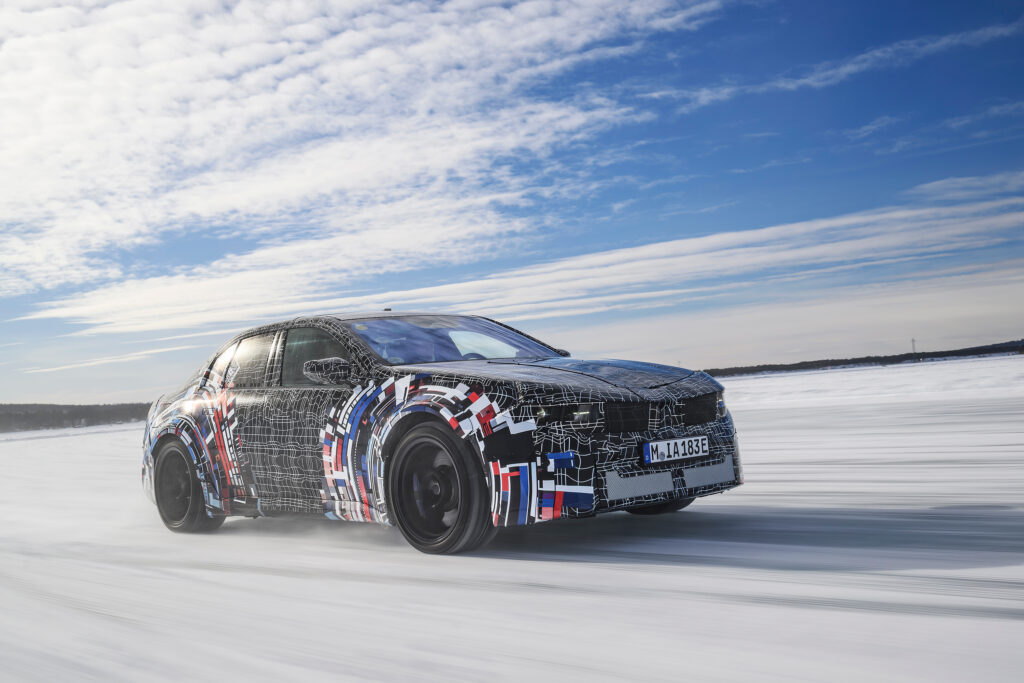
Synthetic gearshifts and artificial soundtracks will be part of the first electric M car, a new M3 built on BMW’s Neue Klasse EV platform, according to the brand.
Expected as early as late 2027, the quad-motor performance saloon will be based on the upcoming electric i3 and will carry serious expectations. Dominik Suckart, BMW’s high-voltage battery chief, said the car has a legacy to uphold.
BMW is still not ready to disclose power figures, but there is clear awareness in Munich that the electric M3 must work hard to preserve M’s reputation for building the most engaging driver’s cars in its class.
Suckart spoke about the goal of making this platform the dynamic benchmark while still delivering a recognisable M feel behind the wheel.
That philosophy explains the inclusion of simulated gearshifts and sound profiles designed to add emotion to the experience. The idea mirrors the approach taken by Hyundai with the Ioniq 5 N and Ioniq 6 N, models developed under the guidance of former BMW M boss Albert Biermann, and likely to be among the new M3’s closest competitors.
Unlike the twin-motor Hyundai setup, the electric M3 will use four motors, each with its own control unit, inverter and reduction gearbox. Advanced torque vectoring will be part of the package.
BMW confirmed the battery will be at least 100 kWh and capable of delivering both strong sustained output and high peak performance. It will also support energy recuperation even when the car is being driven hard, including during heavy braking at the limit of grip.
The car will debut a bespoke software suite called M Dynamic Performance Control, which Suckart says will introduce a new level of handling and traction management.
This system will allow drivers to switch from all-wheel drive to rear-wheel drive for track use or drifting, while also offering an efficient rear-drive mode to help extend range.
It will also feature the Heart of Joy high-performance control unit first seen in the BMW Vision Driving Experience concept. This system integrates key driving functions into a single control architecture to enable faster, more intuitive responses.
BMW added that the battery housing, which forms part of the chassis structure, will be connected to both the front and rear axles on the M3 rather than only the rear as in the standard i3. The goal is improved rigidity.
Modern M cars are no strangers to weight, with the current plug-in hybrid M5 tipping the scales at close to 2.5 tonnes. To counter this, BMW plans to use natural fibres in certain components, as already seen on the M4 GT4 race car, instead of carbon fibre to reduce mass where possible.
Natural fibres also offer an estimated 40 percent lower CO2 emissions equivalent compared to carbon fibre.
Market reception to high-performance EVs remains uncertain, but Suckart remains optimistic, saying the team is excited about what’s coming and believes drivers will be too.
BMW has also hinted strongly that the electric M3 will be joined by a more traditional petrol alternative, powered by an updated version of its well-known B58 straight-six engine.