
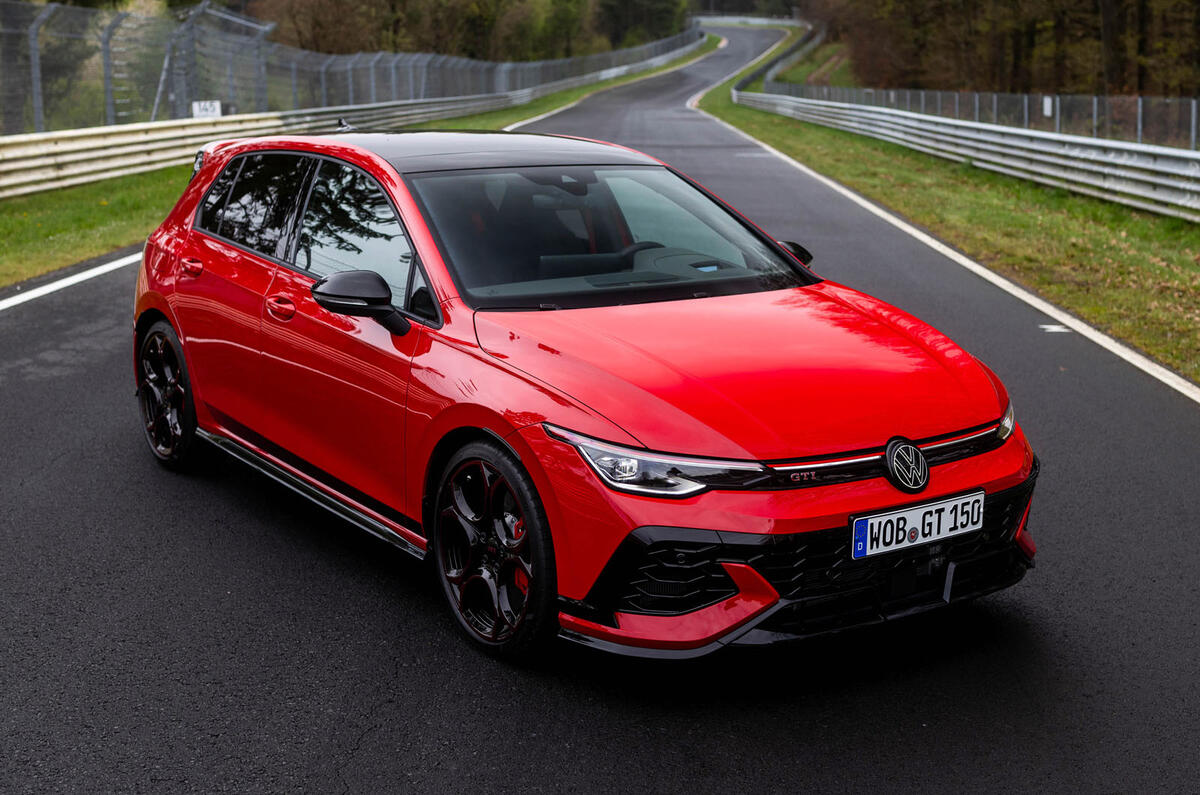
It is the most powerful and what VW calls the most dynamically capable version in the model’s 50-year history, and it has a price to match. In the UK, it will cost £47,995, which makes it more expensive than the range-topping Golf R.
The special hot hatch was revealed last year as part of the GTI badge’s golden jubilee celebrations, marking five decades since its debut in 1975.
It is based on the updated Mk8.5 but runs a stronger version of VW’s turbocharged 2.0-litre EA888 four-cylinder petrol engine, now producing 321 hp (239 kW) and 420 Nm (310 lb-ft).
That is a gain of 60 hp over the standard Golf GTI, and 25 hp over the more track-focused GTI Clubsport. While the four-wheel-drive Golf R 20 Years still holds a slight power edge at 328bhp (245kW), the Edition 50 matches its torque output.
Those extra reserves translate into sharper straight-line performance. The Edition 50 beats the GTI Clubsport with 0-100 km/h (62 mph) in 5.5sec, down by 0.1sec, and 0-200 km/h (124 mph) in 16.9sec, an improvement of 0.4sec. That puts it within touching distance of rivals like the Honda Civic Type R, which claims 0-100 km/h (62 mph) in 5.4sec. Top speed remains limited to 270 km/h (168 mph).
Engineers behind the project are quick to point out that power was not the primary goal. Chassis development boss Lars Frömmig explains that the real focus was capability, saying performance goes far beyond headline figures.
The foundation of the Edition 50’s chassis is a heavily reworked version of the GTI’s MacPherson-strut front and multi-link rear suspension. Ride height is now 20mm lower than the standard GTI and 5mm lower than the GTI Clubsport.
Key changes include revised spring and damper rates and a substantial increase in negative front camber, now around -2.0 degrees. This comes courtesy of stiffer upper mounts, modified wheel carriers and uprated bushings in the lower control arms.
At the rear, the Edition 50 brings back a twin-attachment track rod layout, similar to the Mk7 GTI, alongside new wheel carrier geometry designed to improve lateral stiffness and maintain toe stability under load, especially during high-speed direction changes.
VW has also reworked the software side of the package, recalibrating the electromechanical steering, DCC (Dynamic Chassis Control) and VDM (Vehicle Dynamics Manager) to better suit the more aggressive hardware.
Supporting the chassis upgrades are bespoke 235/35 R19 Bridgestone Potenza Race semi-slick tyres, developed specifically for this model. Each tyre is 1.2kg lighter than the previous-generation Potenza Race and they are mounted to 19-inch forged aluminium Warmenau wheels.
VW claims the wheel and tyre package alone cuts unsprung mass by more than 2kg per corner compared with the Clubsport’s cast wheels and standard tyres, which plays a major role in sharpening steering response. Buyers can shave off a further 11kg by opting for the Akrapovic titanium exhaust system.
Beyond weight savings, the semi-slick tyres improve grip in both dry and wet conditions and feature stiffer sidewalls for better support under load, all aimed at delivering more consistent lap times while retaining real-world usability.
According to Frömmig, the Edition 50 turns in with more authority and offers noticeably better body control than any existing GTI variant. He says there is less roll and a more progressive build-up of lateral force, underlining just how serious VW is about the driving experience here.
The Edition 50 has already backed up those claims with a 7min 46.13sec lap of the Nürburgring Nordschleife, making it the fastest production VW ever around the circuit, including quicker than the four-wheel-drive Golf R 20 Years.
Visually, it sticks closely to the GTI Clubsport’s styling, but there are subtle clues for those who know where to look. These include black graphics along the lower doors, red wheels, 50 decals on the roof spoiler and black tailpipes.