
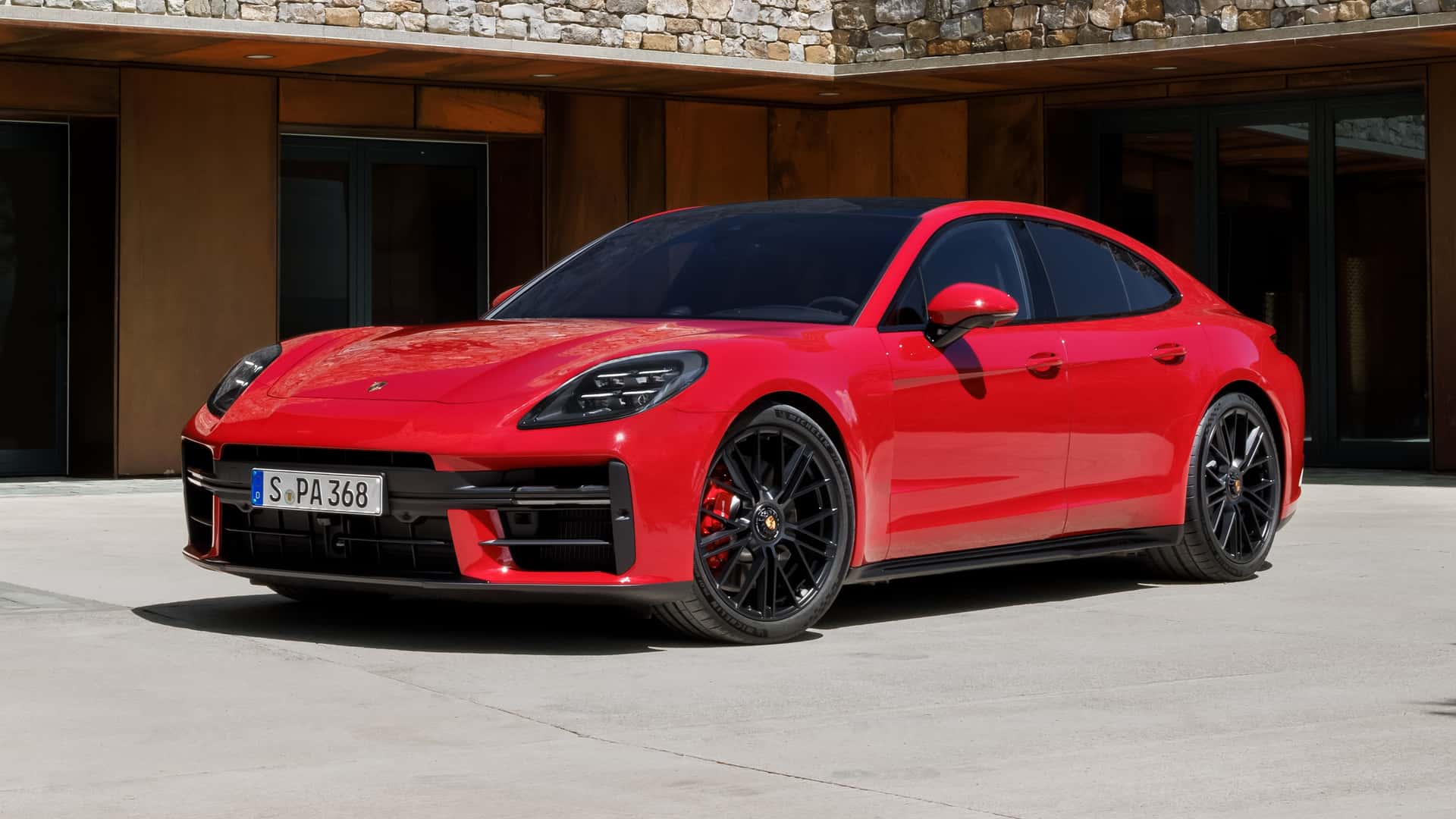
Porsche is reportedly evaluating the idea of combining the Taycan and Panamera into a single model family that would offer petrol, plug-in hybrid and fully electric versions under one nameplate.
The discussions form part of a broader internal effort to reduce spending after slowing global demand and the heavy financial impact of recent strategy changes. Under the leadership of new Porsche CEO Michael Leiters, the company is reassessing several development programmes after the previous electrification roadmap introduced under Oliver Blume was partially scaled back.
Controlling engineering costs has become a major priority, and consolidating two closely positioned luxury performance saloons is understood to be one of the options currently being explored.
Both the Porsche Panamera and Porsche Taycan occupy a similar position in Porsche’s range as high-performance four-door grand tourers. Despite this overlap, the two models currently sit on entirely different technical foundations and have noticeably different body designs.
The Panamera uses Porsche’s MSB architecture, which it shares with the Bentley Continental GT. That platform is expected to be phased out later this decade when the next-generation Panamera arrives, making way for Porsche’s newer PPC architecture.
The Taycan follows a different path entirely. It rides on the J1 platform, the same architecture used by the Audi e‑tron GT. Earlier plans suggested that a second-generation Taycan would eventually transition to Volkswagen Group’s SSP Sport architecture, although delays to that platform have complicated long-term planning.
As the cost of developing standalone EV platforms continues to climb, Porsche is increasingly questioning whether maintaining two separate engineering programmes for the Panamera and Taycan makes financial sense. Industry insiders suggest the brand is studying ways to share more components and potentially merge the two vehicles into a unified product identity, even if future versions continue to run on different underlying platforms.
Porsche already uses a similar strategy elsewhere in its portfolio. The combustion-powered Porsche Macan continues to be sold alongside the fully electric Macan in several markets, even though the two vehicles are built on completely different architectures. A comparable approach is also planned for the Porsche Cayenne, where petrol and electric versions will coexist.
At this stage, it remains unclear whether a combined model line would retain the Panamera badge or transition to the Taycan name.
From a packaging perspective, the two cars are already closely matched in size. The Panamera has a wheelbase of 2950 mm, while the Taycan sits slightly shorter at 2900 mm. The difference is not insignificant, but engineers reportedly believe it would be manageable if the replacement model family were designed from the start to accommodate multiple platforms.
The Panamera’s existing long wheelbase configuration could also play a role in the future strategy. One possible scenario would see the next-generation EV offering two wheelbase options, mirroring the Panamera’s extended variant.
Financial pressures are a major factor behind the discussions. Porsche has already recorded a write down of €1.8 billion (about R36.4 billion) linked to delays and adjustments to upcoming platform programmes. At the same time, the company has warned that profitability will likely decline as it reshapes its long term electrification plans.
Bringing the Panamera and Taycan together into a single product family could reduce development costs across engineering, manufacturing and design while avoiding a situation where Porsche is forced to discontinue one of the models altogether.
Exactly what such a vehicle would look like is still uncertain. However, Porsche’s strategy with the Cayenne may offer a clue. In that range, petrol and electric versions will share a model name while featuring noticeably different exterior designs, giving each drivetrain its own visual identity while still belonging to the same overall product family.