
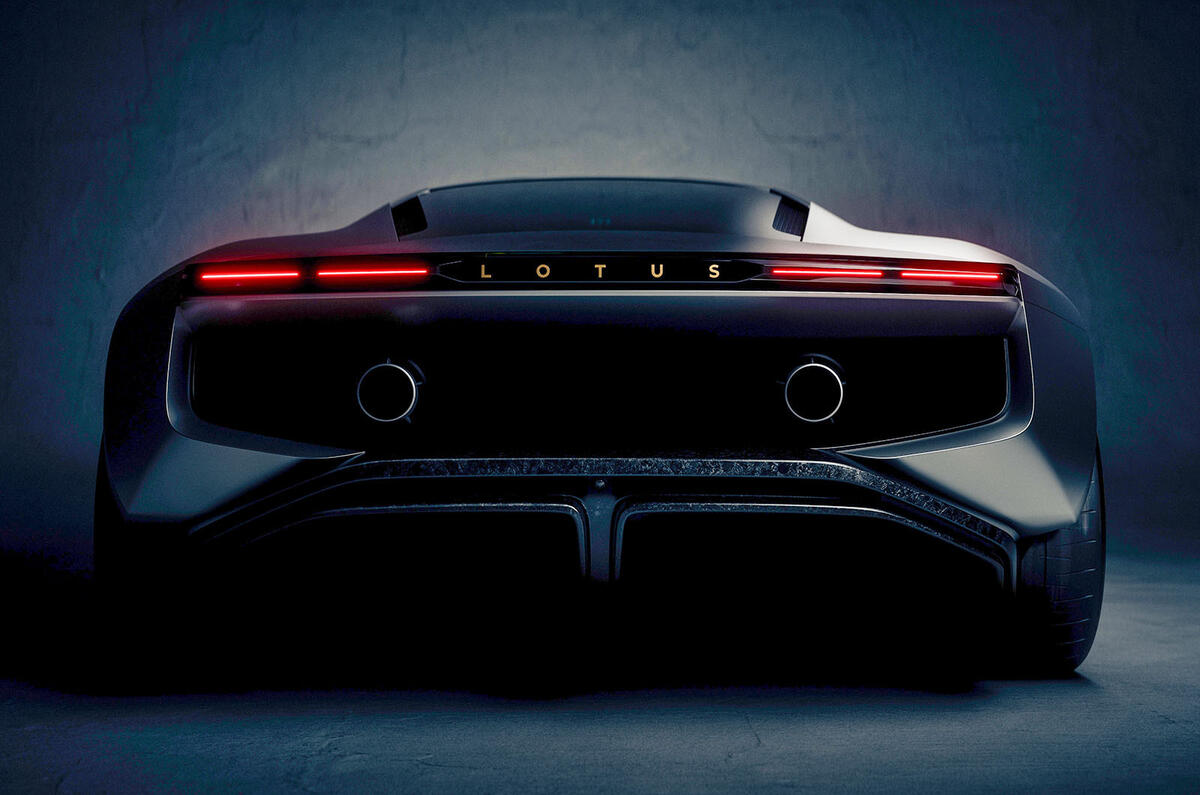
Lotus is preparing to re-enter the combustion-engined supercar arena in 2028 with an all-new V8 hybrid model, marking another clear step away from its previously announced EV-only direction.
The British marque has previewed the rear of the upcoming machine, revealing styling cues inspired by the 2024 Theory 1 concept while also showing off a pair of huge exhaust outlets that leave little doubt about what powers it.
It will be the first Lotus fitted with a V8 since production of the Esprit ended back in 2004, and comparisons between the new model and that iconic car are almost guaranteed.
Lotus says the upcoming supercar will also reconnect with the company’s traditional philosophy of keeping weight as low as possible.
According to CEO Feng Qingfeng, the rebellious DNA established by founder Colin Chapman still plays a major role in the company’s direction today.
Instead of adopting a plug-in hybrid setup like many rivals, Lotus has confirmed the new model will use a regular hybrid system. The company believes avoiding a large battery pack will help preserve lightweight characteristics.
That puts Lotus on a different path to brands such as Aston Martin, Lamborghini and Ferrari, all of which have embraced plug-in hybrid powertrains in models like the Aston Martin Valhalla, Lamborghini Temerario and Ferrari 296 GTB.
Lotus has not officially named the engine supplier, although the company already sources a turbocharged four-cylinder unit from Mercedes-AMG for the Lotus Emira. That relationship could potentially expand to include AMG’s revised M177 4.0-litre twin-turbo V8, which recently gained a flat-plane crankshaft inspired by motorsport applications.
Production is expected to take place in Europe, although Lotus stopped short of confirming whether the car will be assembled at its long-standing Hethel facility alongside the Lotus Evija and Emira.
Development work has been handled at Lotus’s Coventry design studio, the same location responsible for the Theory 1 concept. If more than just styling inspiration carries over, the production model could feature a dramatic three-seat layout similar to the legendary McLaren F1.
Interestingly, the new supercar carries the Type 135 codename, which was initially linked to the now-cancelled electric successor to the Emira.
Before the new flagship arrives, Lotus will reveal an updated version of the Emira in the coming weeks. The company says it will become both the most powerful and lightest Emira ever produced.