
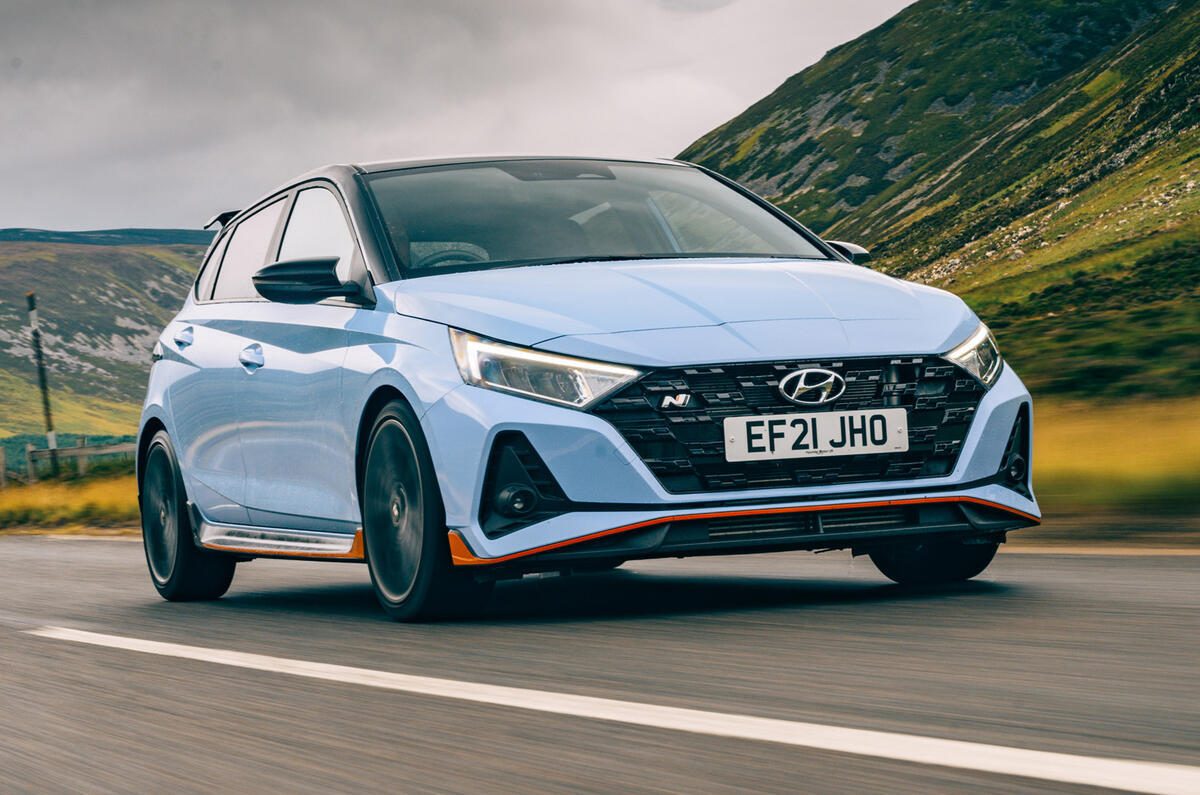
The hot hatch segment has been missing a true performance supermini for a while now, and Hyundai is looking to change that. The next-generation i20 N is in development, and it will pair a turbocharged petrol engine with a hybrid electric system, bringing the N brand back to its more accessible, combustion-focused roots.
A New Foundation for a New Era
The bones of the next i20 have already been revealed through the Brazilian-market version of the standard supermini. Hyundai plans to use that platform as the base for a significantly differentiated European variant, positioned higher and styled more aggressively than the outgoing car. Sitting at the top of the range will be the i20 N, complete with all the visual aggression you’d expect from a proper performance hatch.
The Man Behind the Machine
The i20 N is a passion project for Dr Manfred Harrer, Hyundai’s global head of R&D. The Munich-born engineer built his reputation fixing the steering feel on BMWs and Porsches after those cars made the switch from hydraulic to electric power assistance in the early 2000s.
He’s clear about what this car needs to be. “We need this entry-level back for our fans,” Harrer explained, adding that the new model will be “hybridised” but “not so far out.” A price point of around £30,000 is being targeted, with sales expected to begin within 18 to 24 months.
What’s Under the Bonnet
Power is expected to come from a 1.6-litre turbocharged four-cylinder petrol engine, paired with a twin-motor hybrid transmission developed entirely in-house. That gearbox is engineered to handle outputs of up to 224 kW (300 bhp) and 380 Nm of torque, giving the new i20 N considerably more firepower than the original.
For context, the first i20 N produced 150 kW (201 bhp) and 275 Nm from the same 1.6-litre T-GDi unit, hitting 100 km/h (62 mph) in 6.7 seconds and that was without any electric assistance.
How the Hybrid System Works
Hyundai has engineered a remarkably compact hybrid setup that incorporates two electric motors. The first is a P1 unit that doubles as a starter/generator and can inject torque directly into the drivetrain. The second is a P2 motor capable of providing direct electric drive to the wheels while also recovering energy under braking to charge the battery.
The entire system has been miniaturised to fit within a transversely mounted, front-wheel-drive supermini layout. When asked directly whether the i20 N would use this new 1.6-litre hybrid setup, Harrer grinned and replied: “Maybe. To use existing technology, you have to adjust the battery’s performance and the cooling.”
Tuned to Feel Right
One of the bigger concerns with a hybrid hot hatch is whether it can actually feel exciting to drive. Conventional hybrid powertrains have a habit of delivering power in a rubbery, detached way which is not ideal when you’re trying to feel connected to a circuit.
Harrer is well aware of this. A committed car enthusiast, he has always insisted that N cars must be at home on tracks like the Nürburgring. As for whether the hybrid system can deliver the kind of crisp, surge-and-snap power delivery that hot hatch fans want? “It will feel like that,” he assured us.
The original i20 N came with a limited-slip differential, and the new model will almost certainly follow suit to ensure clean traction out of corners.
Why Hybrid and Not Pure Petrol?
Europe’s tightening emissions rules make a pure petrol performance car increasingly difficult to justify. The current 95g/km CO2 fleet average target drops to 50g/km in 2030, and Martinet made no attempt to shy away from this reality. “Launching a pure petrol without hybridisation — how would that be perceived by the market? We aren’t living in the 20th century,” he said.
The hybrid i20 N, then, is both a passion project and a pragmatic one. The goal is to set the benchmark in a segment that’s been largely dormant since the Ford Fiesta ST, the Renaultsport Clio and the Volkswagen Polo GTI all went out of production. And Harrer’s response when asked what car the i20 N will aim to beat? “We will inspire others to benchmark us.”