
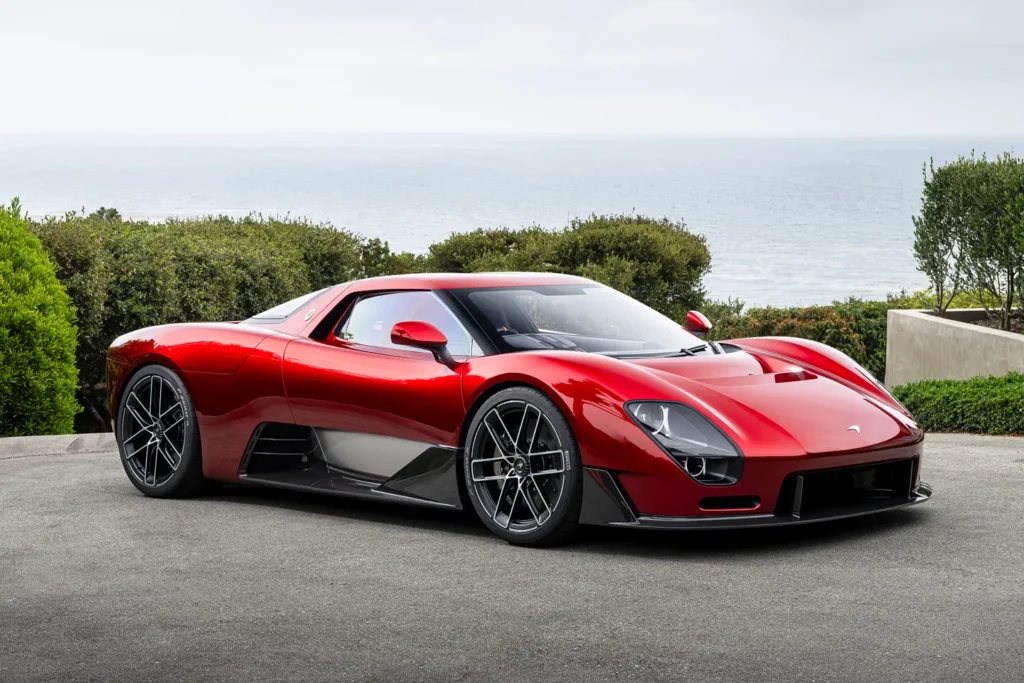
McLaren’s next production supercar has a name and a power figure. The McL 820 will arrive in 2027 to replace the 750S, bringing 809 hp (603 kW) and a fresh naming direction for the British manufacturer.
With the 750S set to bow out in 2027, attention now turns to how McLaren plans to replace one of its most accomplished driver’s cars.
What Does McL 820 Mean?
The number follows familiar McLaren logic: 820 refers to its output in metric horsepower, equivalent to 809 hp (603 kW). That gives the newcomer approximately 69 hp (51 kW) more than the outgoing 750S.
The McL prefix draws on the company’s motorsport heritage and signals a revised approach to naming its production cars.
Hybrid V8 Power Expected
McLaren has yet to detail the powertrain, although a hybrid V8 is expected. Previous comments from the manufacturer suggest the technology developed for the W1 will underpin future supercars. The precise specification for the McL 820 remains unconfirmed.
The McLaren W1 shows what that hardware can deliver at the top of the range. Its twin-turbocharged V8 and electric assistance produce a combined 1,258 hp (938 kW), while its quoted lightest dry weight is 1,399 kg.
Those figures belong to the flagship, though. They should not be taken as confirmation of the replacement’s engine, battery or transmission.
Ferrari 296 GTB Provides The Benchmark
The McL 820’s announced output puts it close to the Ferrari 296 GTB, whose hybrid V6 produces 819 hp (610 kW). Ferrari quotes a 0 to 100 km/h (62 mph) time of 2.9 seconds and a maximum speed exceeding 330 km/h (205 mph).
As we covered when the Ferrari 296 GTB was revealed, electrification helped turn its smaller engine into a serious performance proposition.
McLaren already has a strong starting point. The 750S produces 740 hp (552 kW) and 800 Nm (590 lb-ft), reaches 100 km/h (62 mph) in 2.8 seconds and tops out at 332 km/h (206 mph). Extra power gives its successor potential, but acceleration and maximum speed have not been announced.
Weight Will Be Worth Watching
If the expected hybrid system materialises, its integration will be as interesting as the headline output. Batteries and electric motors add another challenge to a formula built around low mass and a carbon-fibre structure.
The question is how much of the 750S’s immediacy and agility McLaren can carry into its next generation. A stronger power figure is welcome, but the finished car’s weight and responses will tell us more about the result.
Reveal Planned For 2027
Further details are due in 2027. For now, the name, output and replacement role are the key confirmed elements. Pricing, final performance figures and South African availability remain outstanding.