
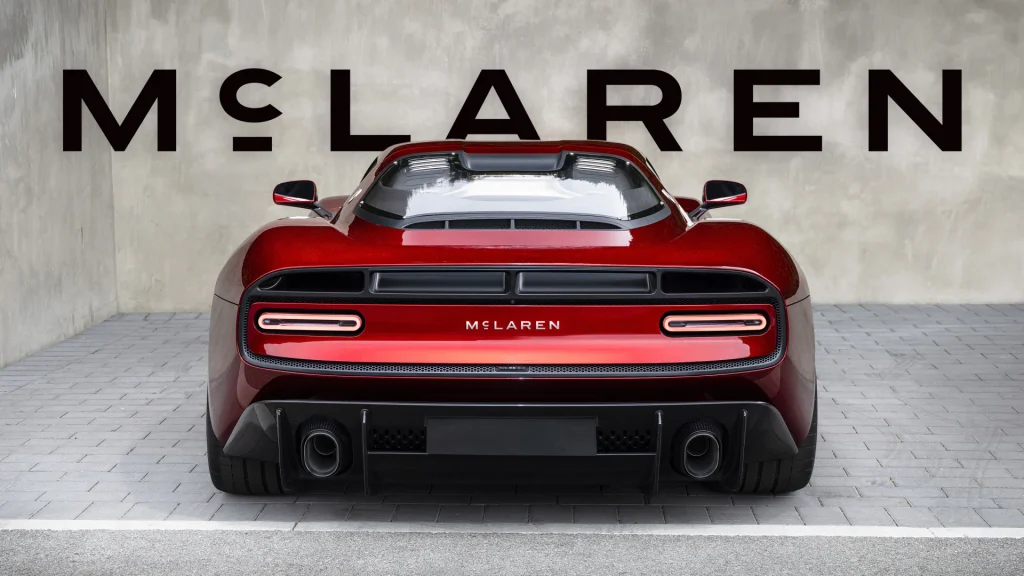
McLaren is entering a very different chapter, and it now has a new identity to go with it.
The British supercar manufacturer has revealed a redesigned wordmark that will be used across both McLaren Automotive and McLaren Racing. Rather than simply modernising the familiar badge, the company has gone right back to its beginnings for inspiration.
McLaren’s New Logo Looks Back To Bruce McLaren’s Roots
The new lettering traces its origins to the service station operated by Bruce McLaren’s parents in Auckland, New Zealand.
The typeface takes inspiration from the signage that appeared above the family’s garage, a particularly fitting reference considering it was there that a young Bruce began developing his mechanical skills.
At just 14 years old, he rebuilt a 1929 Austin 7 Ulster that would later give him his first taste of motorsport success.
More than six decades later, McLaren has evolved into one of the world’s best-known racing and supercar manufacturers, but the company’s new identity deliberately reconnects the modern business with those early years.
A Much Cleaner McLaren Wordmark
Visually, the new logo is considerably more restrained than the bold McLaren lettering that has evolved since the early 1980s.
The design uses a wide sans-serif typeface, predominantly in capital letters. The exception is the distinctive lowercase ‘c’, which sits above a horizontal line to visually align it with the surrounding characters.
McLaren’s familiar Speedmark isn’t disappearing, either. The Speedy Kiwi and Speedmark will continue to form important parts of the brand’s identity alongside the new lettering.
The revised wordmark will now be rolled out across McLaren Automotive and McLaren Racing.
McL 6GT Is First To Wear The New Badge
There couldn’t be a more appropriate car to introduce the new identity than the McLaren McL 6GT.
Revealed during Monterey Car Week, the concept reaches back to Bruce McLaren’s M6GT, an ambitious attempt to turn the company’s competition expertise into a road-going machine.
The original M6GT never developed into the production car Bruce had envisioned, but the new McL 6GT effectively picks up that idea more than half a century later.
McLaren has confirmed that the car uses a V8 combustion engine, rear-wheel drive and a genuine manual transmission. That makes it the first McLaren since the legendary F1 to feature three pedals.
It also features lightweight carbon fibre construction and hydraulic steering, deliberately putting mechanical driver involvement ahead of outright technological complexity.
The production version isn’t expected to arrive until 2028.
£500 Million Investment Signals Bigger McLaren Plans
The branding overhaul arrives as McLaren prepares for one of the largest expansions in its recent history.
The company has announced a £500 million (approximately R10.87 billion) investment into its UK manufacturing and engineering operations. The money will help support a considerably broader future product portfolio.
Perhaps the biggest departure from McLaren tradition will be its first high-performance SUV.
After years of distancing itself from the idea of building one, McLaren has now confirmed that a performance SUV forms part of its future plans. It will push the manufacturer beyond the two-seat supercars that have defined its modern road-car business.
The company is also preparing a wider overhaul of its model range as it looks towards the end of the decade.
McLaren’s Past Is Shaping Its Future
There is a clear theme running through McLaren’s latest moves.
While its future line-up is set to expand significantly, the company is simultaneously leaning harder into the history created by Bruce McLaren. The McL 6GT, return of the manual gearbox, Speedy Kiwi and now the heritage-inspired wordmark all point in the same direction.
The new logo may be a relatively small change compared with the cars McLaren has planned for the coming years, but it provides a clear indication of how the company wants to position its next era.