
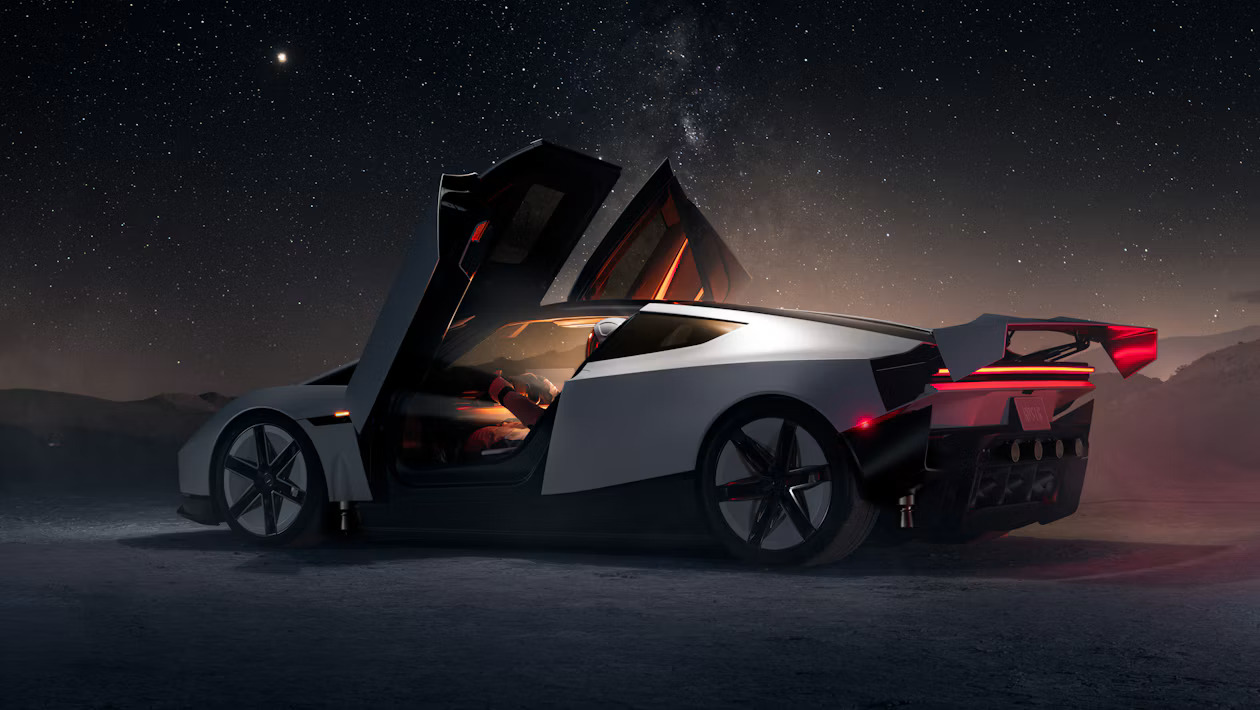
Tesla’s new Roadster has already delivered a launch few carmakers would even attempt. After driving upside down and performing an airborne barrel roll over other Teslas, including the Semi, the electric sports car hardly needed another headline. Elon Musk supplied one anyway: a top-speed ambition approaching half the speed of sound.
That translates to roughly 617 km/h (383.6 mph), depending on atmospheric conditions. It is also a long way from a speed Tesla has actually demonstrated.
Elon Musk Wants The Tesla Roadster To Reach Over 600 km/h
The Roadster’s reveal put its top speed above 370 km/h (230 mph), but Musk suggested he wants considerably more. During the presentation, he floated the idea of reaching at least half the speed of sound. For now, that remains an ambition rather than a verified performance figure.
Even by hypercar standards, around 617 km/h (383.6 mph) would be extraordinary. Getting there would demand far more than the acceleration needed to produce an impressive launch demonstration.
There is also a crucial distinction between a prototype performing a carefully prepared stunt and a customer car repeatedly delivering its advertised capabilities.
How It Compares With The Yangwang U9 Xtreme
The benchmark Musk would need to beat is substantial. BYD’s Yangwang U9 Xtreme recorded 496.22 km/h (308.34 mph) at Germany’s ATP Papenburg test facility, with production limited to no more than 30 examples.
As covered in our report on the Yangwang U9 Xtreme’s record-breaking run, electric hypercars have already pushed beyond the territory once dominated by Bugatti.
Achieving Musk’s suggested figure would put the Roadster roughly 121 km/h beyond that recorded speed. That is a huge leap at a point where even small gains become increasingly difficult.
Yangwang’s progress from the earlier U9 Track Edition’s high-speed testing also shows how much development can sit between an ambitious target and a successful run.
A Spectacular Reveal Still Leaves Plenty To Prove
Tesla’s demonstration certainly gave people something to talk about. Alongside the airborne manoeuvres, the company claimed a 0 to 97 km/h (60 mph) time of just 0.81 seconds, measured using a one-foot rollout. That timing detail matters when comparing it with acceleration figures measured from a complete standstill.
A maximum-speed attempt presents a different challenge. Tyres, aerodynamic stability, cooling and the space needed to accelerate and stop would all require serious attention. An impressive sprint does not establish what a car can safely achieve at its absolute limit.
Tesla has shown that its prototype can put on a remarkable display. It has yet to demonstrate anything close to the speed Musk has proposed.
The Production Roadster Will Have The Final Say
After years of delays, the Roadster needs customer deliveries as much as it needs headline numbers. Musk now points to production beginning in 2028, giving Tesla another deadline against which the project will be judged.
Until then, the sensible approach is to separate demonstrated capabilities, manufacturer claims and future ambitions. The reveal was memorable. A production Roadster capable of approaching 617 km/h (383.6 mph) would be a much bigger achievement.
For now, Musk has set the target. Tesla still has to build the car that can reach it.