
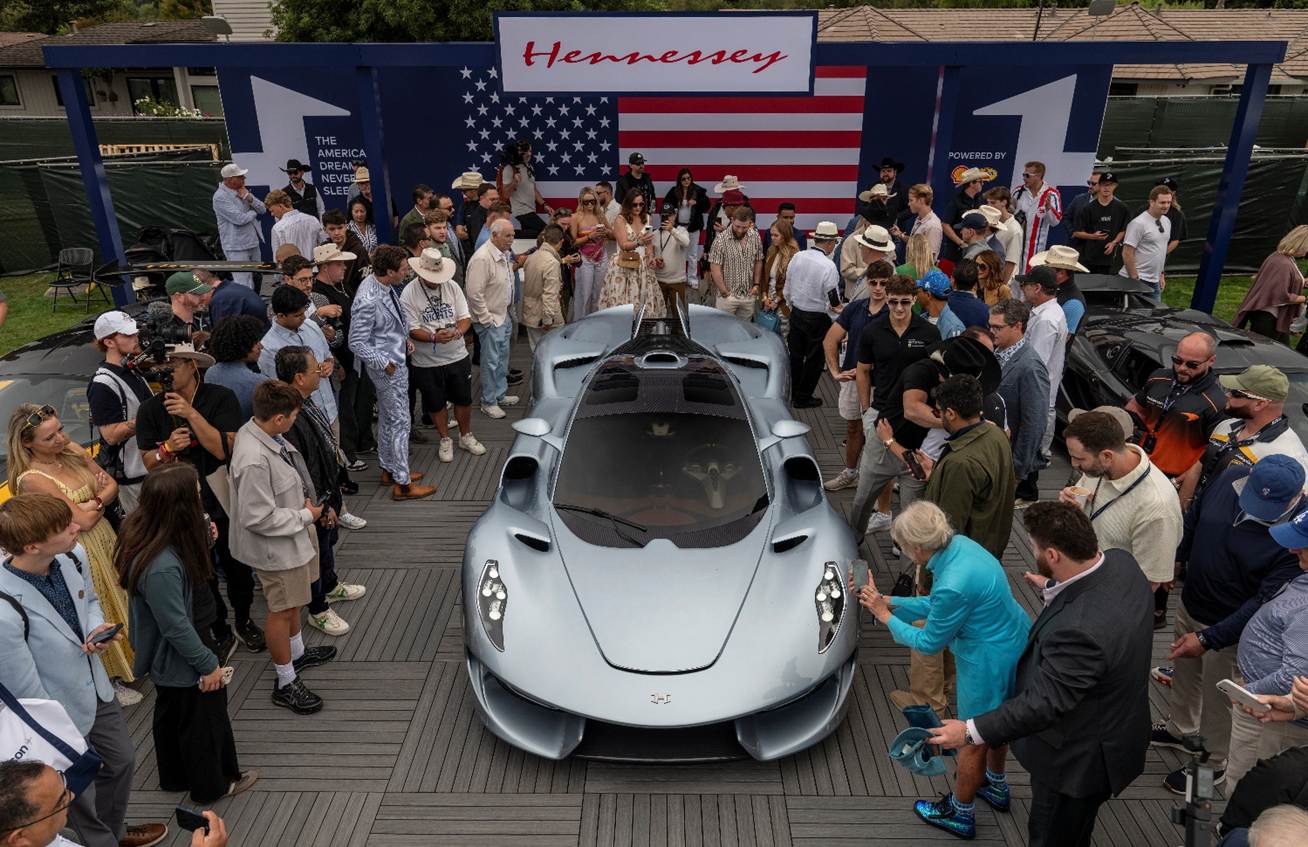
Hennessey’s new Blackbird has barely had time to enjoy the spotlight and every example is already spoken for.
All 71 production slots for the new Hennessey Blackbird have now been allocated, with the final cars snapped up just four hours after its public debut during Monterey Car Week in California.
The rapid sellout suggests there is still serious demand at the top end of the market for something relatively old-school: a naturally aspirated engine, three pedals and a hypercar designed around the person behind the wheel.
Hennessey Blackbird Sells Out Almost Immediately
Hennessey had already secured buyers for more than 60 of the planned 71 cars before the Blackbird appeared publicly at The Quail.
That meant only a small number of allocations were still available when the covers came off. Within four hours, those remaining build slots were gone.
According to company founder and CEO John Hennessey, the response exceeded expectations. He believes buyers are increasingly looking for cars that move away from complicated hybrid systems and screen-heavy interiors, with the Blackbird instead concentrating on driver involvement and mechanical character.
It is a very different proposition from the company’s hugely powerful Venom F5-M, but one that clearly hasn’t struggled to find customers.
Naturally Aspirated V8 And Six-Speed Manual
At the centre of the Blackbird is an all-new naturally aspirated 6.2-litre V8 developed in collaboration with Ilmor Engineering.
Hennessey is targeting between 800 hp (597 kW) and 850 hp (634 kW), with the engine capable of revving beyond 9,000 rpm.
Rather than chasing enormous outputs through turbocharging or electrification, the Blackbird sends its power through a six-speed manual gearbox.
That combination should make it one of the more unusual modern hypercars, particularly as manufacturers continue moving towards hybrid-assisted powertrains and increasingly sophisticated transmissions.
Serious Performance Without Chasing Huge Numbers
While the Blackbird’s focus is firmly on the driving experience, it is hardly lacking in straight-line performance.
Hennessey is targeting a 0 to 97 km/h (60 mph) time of 2.5 seconds, while top speed is expected to reach approximately 354 km/h (220 mph).
The car uses a bespoke full-carbon monocoque combined with carbon-fibre bodywork, helping Hennessey target a kerb weight below 1,361 kg (3,000 lbs).
Adaptive suspension is also part of the package, alongside ABS, traction control and Michelin Pilot Sport Cup 2 tyres.
A Hypercar Designed To Actually Cover Distance
The Blackbird isn’t intended to be another stripped-out machine that is only enjoyable on a perfect road or racing circuit.
Hennessey has given it a comfortable cabin and meaningful luggage capacity, allowing owners to use the car for longer journeys rather than simply adding it to a collection.
That approach separates it from more extreme versions of the Venom F5, including the track-focused Venom F5 Revolution.
The design itself takes inspiration from the legendary SR-71 Blackbird reconnaissance aircraft, but the philosophy behind the car is refreshingly straightforward: low weight, a high-revving naturally aspirated engine, manual gearbox and as little interference between the driver and car as possible.
$2.5 Million Price Tag Didn’t Slow Buyers Down
Pricing for the Hennessey Blackbird starts at $2.5 million (approximately R40 million) before taxes.
Despite the substantial price, Hennessey had no trouble filling the 71-car production run. The Blackbird becomes the third hypercar developed by Hennessey Special Vehicles, following the Venom GT launched in 2010 and the Venom F5 that arrived in 2021.
The speed at which the final allocations disappeared also says something interesting about the current hypercar market. Huge horsepower figures and hybrid technology may dominate the headlines, but there is clearly still a wealthy group of enthusiasts willing to spend millions on something deliberately more mechanical.
With every Blackbird already sold, Hennessey’s decision to focus on analogue driving pleasure appears to have paid off.