
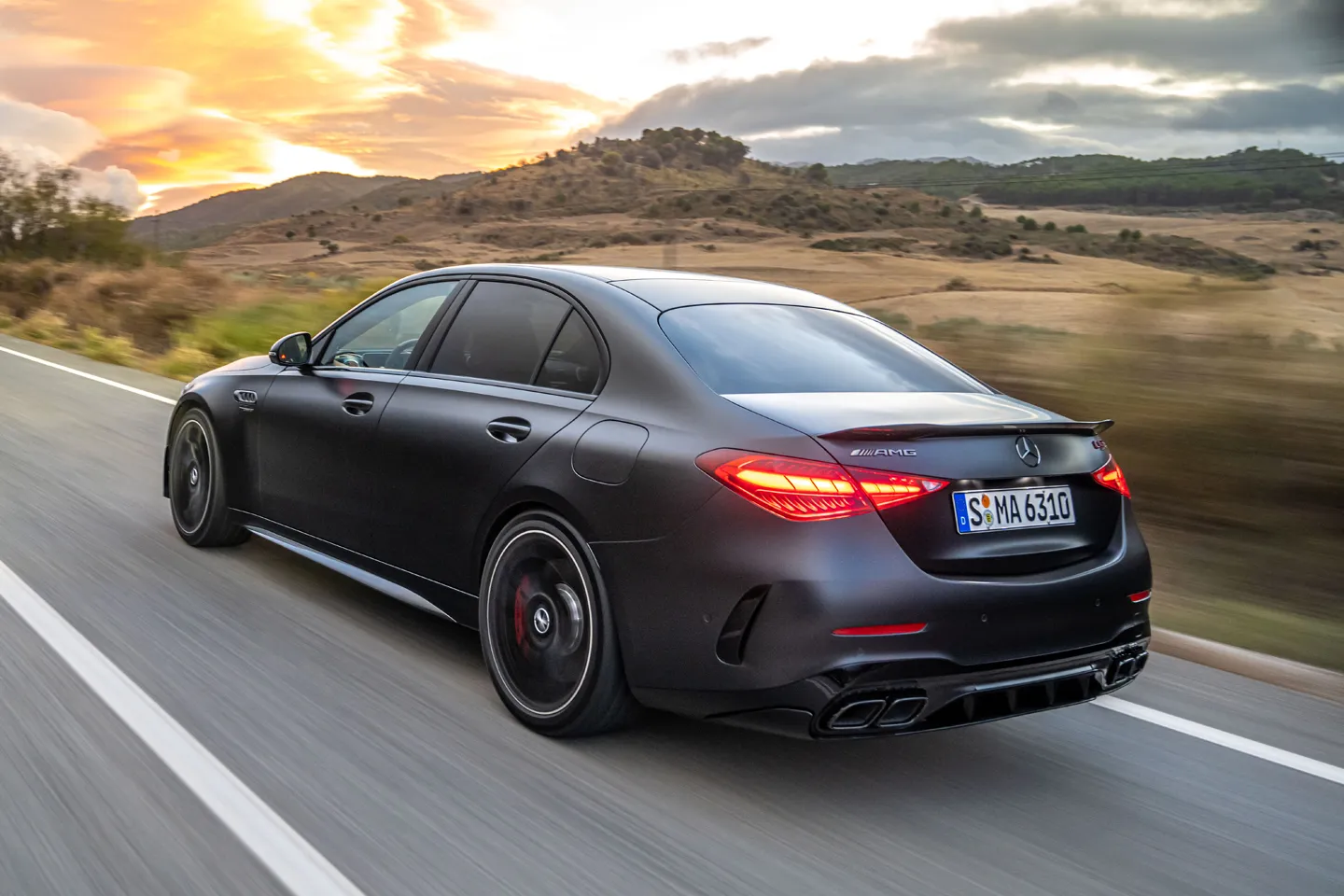
Mercedes isn’t ready to call time on the V8. Despite increasingly strict emissions rules and the industry’s push towards electrification, the German manufacturer expects eight-cylinder engines to remain part of its line-up well into the next decade.
For AMG fans, that is undoubtedly good news. For anyone hoping it means the current Mercedes-AMG C63 is about to regain its V8, the situation is rather different.
Mercedes V8 Engines Will Survive Beyond 2030
Mercedes-Benz head of product management Klaus Rehkugler has confirmed that the company intends to continue offering V8 engines well into the 2030s, potentially until at least 2035.
There is still strong demand for eight-cylinder Mercedes models in markets such as the United States and Middle East, particularly in larger vehicles including the S-Class, G-Class and GLE.
Europe presents a much bigger challenge. Increasingly restrictive CO2 legislation is making large combustion engines more expensive and difficult to justify, while China is also moving rapidly towards electrification.
Mercedes believes there is enough demand elsewhere to keep the V8 alive for roughly another decade.
The Four-Cylinder C63 Hasn’t Won Everyone Over
The decision to replace the previous C63’s twin-turbocharged V8 with an electrified four-cylinder engine remains one of AMG’s most controversial moves.
At the heart of the current C63 S E Performance is the 2.0-litre M139 turbocharged four-cylinder. In its most powerful form, the engine itself can produce up to 469 hp (350 kW), an extraordinary figure for an engine of this size.
Combined with its electric hardware, the C63 offers enormous performance, but outright numbers haven’t been enough to replace the character buyers associated with the old V8-powered models.
Mercedes made the switch while preparing for emissions regulations that were expected to become increasingly severe. Since then, however, the regulatory and market landscape has evolved, allowing the company to reconsider how quickly combustion engines need to disappear.
No V8 Comeback For The Current Mercedes-AMG C63
Despite Mercedes recommitting to V8 power elsewhere in its range, Rehkugler has effectively ruled out fitting one to the current-generation C63.
The problem isn’t simply whether customers want one. Mercedes would need to engineer, homologate and produce the V8-powered derivative with enough time remaining in the current C-Class lifecycle to recover that investment.
The W206-generation C-Class made its debut in 2021 and is approaching its mid-cycle update. With an entirely new generation expected before the end of the decade, there simply isn’t enough time for Mercedes to make a V8 conversion financially worthwhile.
That means the current C63 is expected to remain without eight-cylinder power.
Next-Generation C63 Could Be A Different Story
Things become considerably more interesting when looking further ahead.
Mercedes hasn’t ruled out a V8 for the next-generation C-Class. With that model expected towards the end of the decade, AMG would have an entire product lifecycle over which to justify the engineering costs.
Whether that happens will ultimately depend on emissions legislation and, perhaps more importantly, customer demand.
Mercedes is already preparing to expand the use of V8 power across other models. The CLE is expected to benefit from an eight-cylinder engine, while new-generation V8 technology developed for larger Mercedes models could eventually find its way further down the range.
AMG V8 Sound Is Facing Another Problem
Keeping the engine alive is only part of the challenge.
Increasingly strict noise regulations are also limiting some of the characteristics AMG owners have traditionally enjoyed. Features designed to create pops, crackles and other exhaust theatrics are becoming increasingly difficult for manufacturers to retain.
So while the V8 itself looks safe for several more years, future AMG models may sound more restrained than their predecessors.
For enthusiasts, however, the bigger takeaway is encouraging. Mercedes-Benz isn’t abandoning the V8 just yet, and if demand remains strong enough, there is at least a possibility that a future C63 could once again receive the engine many buyers believe it should never have lost.