
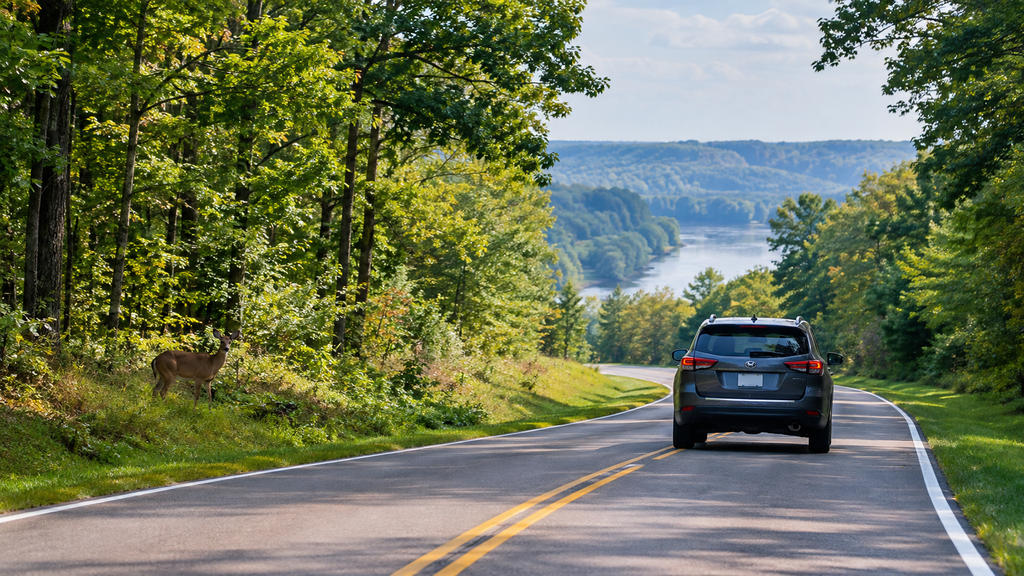
Turn onto the Natchez Trace from I-40 west of Nashville and something changes almost immediately. No billboards. No gas stations. No semis. Just two narrow lanes bending through hardwood forest, forcing you down to a pace that feels almost old-fashioned. That’s the appeal. It’s also exactly what trips people up when they treat it like any other road.
The Tennessee stretch, from the Alabama line up to Nashville, has its own rulebook, its own wildlife patterns, and its own way of turning a lazy afternoon drive into an insurance claim.
It’s a park road, not a highway
The National Park Service runs the Trace, all 444 miles of it, and that shows in how it’s built. Commercial trucks aren’t allowed anywhere on the route. Speed tops out at 50 mph almost everywhere, except one stretch in Tennessee: from Leiper’s Fork up to the parkway’s end near Highway 100, the limit drops to 40. The road tightens up there, more curves, more local traffic, less room for error.
No real shoulder in most places either. Lanes are narrower than what you’d find on a state highway, and the curves were put there on purpose, to show off the scenery rather than move cars efficiently. Cyclists ride the same pavement, legally, and hikers cross at trailheads without much warning. Texting behind the wheel is illegal in Tennessee like everywhere else, but on a road this tight, looking down for three seconds means something different than it does on I-40.
The mile markers themselves take some getting used to too. They count up from the Mississippi end, so Tennessee drivers coming in from the south are watching the numbers climb toward 444 rather than count down to zero. Small thing, but it throws people off when they’re trying to gauge how much of the drive is left based on habit from other numbered routes.
The deer problem nobody mentions until it happens to them
Here’s the number that surprised me when I first looked it up: about a third of all reported crashes on the entire parkway involve deer. The Park Service’s own data puts 90 percent of those collisions between September and March. That’s not a footnote. For half the year, deer are arguably the biggest risk on this road, bigger than other drivers.
Tennessee’s section cuts through some of the thickest forest on the whole route. Dawn and dusk is when deer move. Drive the Leiper’s Fork stretch at 6:30 on an October evening and you’re driving straight into the conditions where a strike is most likely.
One thing the rangers say, and it’s worth repeating because instinct tells you the opposite: if a deer bolts into the road, don’t swerve. Swerving on a curvy, shoulderless two-lane is far more likely to put you in a tree than the deer strike would’ve hurt you. Hit the deer. Stay with the car. Call 911, or the park’s own dispatch line, rather than driving on and hoping the damage is cosmetic.
None of this is meant to scare anyone off the drive. Plenty of people run this stretch every week without incident. It’s just that the risk profile here is different from what most drivers are used to calibrating for, and deer are a big part of that difference, not a minor one.
Gas up before you commit
There’s no fuel on the parkway. None. You exit, find a town, and hope the exit spacing works in your favor, because it doesn’t always. On the Tennessee side, the stretch from the Alabama line to Nashville runs close to 100 miles, and that’s a long way to be guessing about your tank.
Check where the fuel stops are before you get on, not fifteen miles into a section with no exits and a needle creeping toward E.
Weather turns this road hostile fast
Long remote stretches, and the Park Service is blunt about it: don’t drive severe winter weather or thunderstorms out here if you can help it. Overhanging trees come down in storms. The same curves that make the drive pretty also cut your sight line when you need it most, which is a bad combination when a branch is down around the next bend.
Spring and summer in Tennessee bring their own fast-moving storm cells. A blue sky can turn into a fifteen-minute white-knuckle crawl. If radar shows something building before you leave, wait it out. There’s nowhere good to pull off out here, and cell coverage gets spotty in the deeper wooded sections, so you don’t want to be figuring that out mid-storm.
What your policy actually needs to cover
Tennessee’s minimum is 25/50/25, set under T.C.A. § 55-12-102: $25,000 per person and $50,000 per accident in bodily injury, plus $25,000 in property damage. That’s the legal floor for any Tennessee road, Trace included. It has nothing to do with what happens to your own car after you hit a deer.
That’s the gap that matters here. Liability doesn’t touch your own vehicle. Comprehensive does, and on a road where a third of crashes involve wildlife, comprehensive is arguably doing more work than collision. If you dropped it to shave a few dollars off an older car, or you genuinely don’t remember whether you’re carrying it, that’s worth confirming before you head out, not after a deer walks out of the treeline. Check the deductible too while you’re at it. A high comprehensive deductible on a deer strike can eat most of what you’d otherwise recover, especially on a repair that runs a couple thousand dollars for a bumper and a headlight assembly.
The Tennessee Department of Commerce and Insurance has consumer guidance on coverage requirements and what to do after a crash, including how the claims process works, if you want to see how a wildlife-collision claim differs from a standard fender bender.
Before you leave
- Confirm comprehensive is actually on your policy, especially on an older or paid-off car.
- Fill up before any long stretch. There’s nothing out there.
- Check the radar. Push the trip if storms are building.
- Driving dawn or dusk between September and March, drop below the posted limit in the wooded sections.
- Save 911 or the parkway dispatch number somewhere you’ll actually find it, since cell service isn’t guaranteed.
For anyone shopping around before a trip like this, searches for car insurance Tennessee turn up a mix of the usual national names and smaller regional carriers, GoAuto Insurance among them, a regional company writing low-cost policies across Tennessee and a handful of other states. Whoever you end up with, the thing to actually check before a Trace drive is comprehensive coverage. The liability minimum just gets you registered.
Bottom line
The Trace rewards patience and punishes the assumption that it’s just another road. Fuel up early. Watch hardest for deer at dawn and dusk, fall through winter. Don’t swerve if one runs out. And make sure your policy covers your own car, not just the other guy’s, before you turn onto it. Nashville is a nice place to end the drive either way, but you want to get there with your bumper intact.