
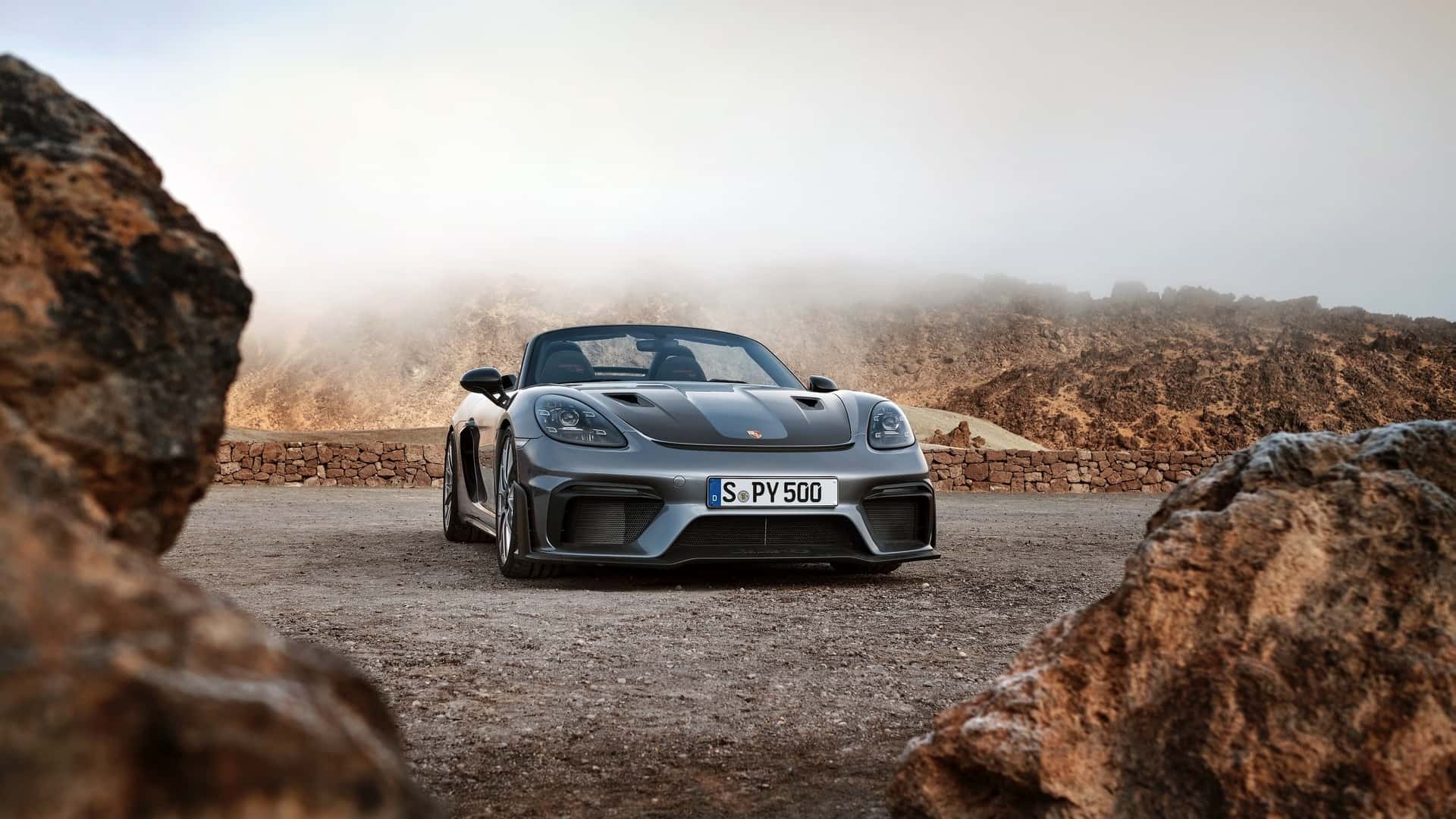
Porsche is gearing up to rework its next-generation 718 Boxster and Cayman architecture to accommodate petrol power, marking a sharp change of direction after previously committing the models to an electric-only future.
Production of the fourth-generation Boxster and Cayman wrapped up last month, clearing the way for all-new, bespoke electric replacements due to arrive this year. However, with global EV demand losing momentum, Porsche had already confirmed it would keep selling ‘top’ versions of the outgoing cars, widely expected to be the RS and GT4 RS, alongside the new electric models.
That announcement formed part of what Porsche described as a ‘strategic realignment’, a rethink that reportedly cost the company over £6 billion as it scaled back several electric vehicle ambitions.
Now, senior insiders at Porsche’s Weissach engineering centre have told Autocar that the brand is also actively working on bringing petrol-powered Boxster and Cayman models back into the range. This would be achieved by effectively reverse-engineering the EV-only PPE Sport platform, originally developed for the 2026 electric successors, so that it can house a mid-mounted combustion engine.
The goal is to maximise production efficiency and economies of scale across major components, but the move also stands out as one of the most dramatic drivetrain reversals in Porsche’s history.
This decision sits within a broader recalibration of Porsche’s model strategy. Other cars once destined to go fully electric, including the Macan, are now also slated to receive fresh internal combustion options.
Importantly, these new 718s differ from the ‘top’ 718 variants Porsche referenced during September’s strategic update. Those earlier cars are expected to be continuations of the current RS and GT4 RS models, positioned above the electric versions when they arrive in 2026. The latest information suggests they will serve as a stopgap, bridging the gap until an all-new fifth-generation Boxster and Cayman land later in the decade.
Porsche engineers are clear that for the fifth-generation ICE cars to make sense, they must match the dynamic performance of their electric counterparts. That is a demanding target, especially given the ‘ultra-low centre of gravity’ delivered by the electric platform’s battery layout.
Meeting that benchmark will not be straightforward. The PPE Sport architecture relies on a stressed, load-bearing battery pack and a flat floor, meaning its removal would significantly compromise the rigidity of the bodyshell.
To counter this, engineers are said to be developing a new structural floor section that bolts into the platform’s existing hard points, restoring lost stiffness. A redesigned rear bulkhead and subframe would then carry the engine and transmission.
Packaging remains a major headache. The electric platform has no central tunnel and no allowance for a fuel tank, fuel lines or an exhaust system. According to sources, solving this would likely require an entirely new rear structure, as the architecture was never intended to support a petrol drivetrain.
Previously, Porsche had concluded that its naturally aspirated 4.0-litre flat-six could not meet the EU’s original Euro 7 emissions targets, which would have required bulky particulate filters and complex after-treatment systems. However, the softened final regulations, combined with the EU’s post-2035 e-fuel exemption, have reopened the business case for new petrol-powered sports cars.
Exactly which engine will power these revived models has yet to be finalised. That said, plans outlined by outgoing Porsche CEO Oliver Blume point to an evolved version of the 4.0-litre flat-six introduced to the 718 range in 2020, an engine that already delivers up to 493 hp (368 kW) in GT4 RS guise.