
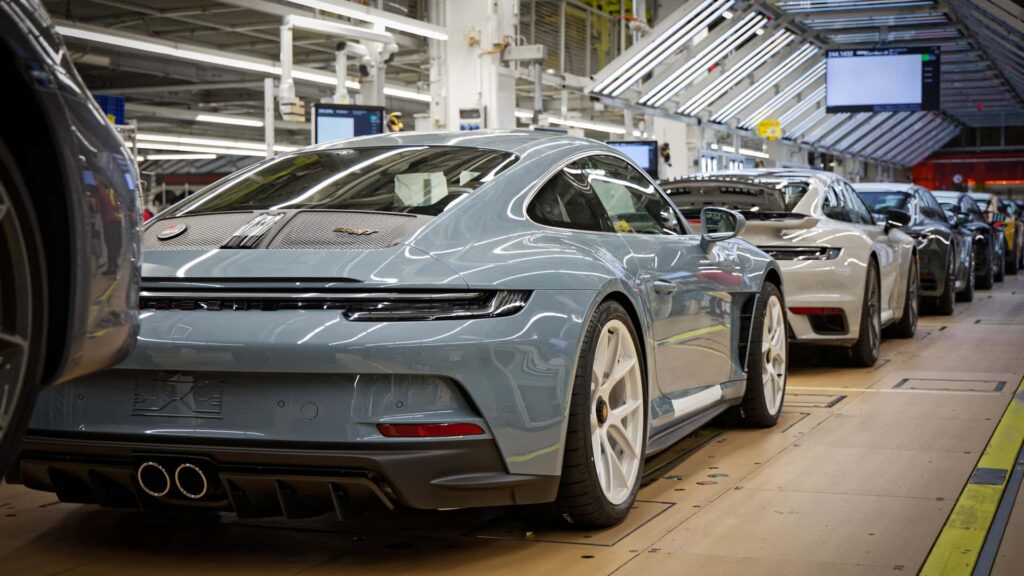
Porsche‘s ‘golden era’ appears to be firmly in the rearview mirror. After setting an all-time sales record of 320,221 vehicles delivered globally in 2023, the Stuttgart brand has spent the two years since fighting a combination of headwinds that have taken a meaningful toll on its business.
China Slowdown and Regulatory Hurdles Hit Hard
Two factors have been particularly damaging. The first is a steep drop in demand from China, where surging domestic competition has eroded Porsche’s once-enviable market position. The second is the forced withdrawal of the Macan and 718 models from the European market after both failed to comply with updated cybersecurity regulations, slicing a significant chunk from the sales tally.
By 2025, total deliveries had slipped to 279,449 units, a figure roughly equivalent to what Porsche was moving back in 2020. The opening quarter of 2026 brought little comfort, with demand down 15 percent year-on-year to just 60,991 cars.
Fewer Cars, Bigger Margins
Rather than chase volume, Porsche CEO Michael Leiters is charting a different course. Speaking to German newspaper Frankfurter Allgemeine Zeitung, he was direct about the new strategy: the brand must remain profitable even as it produces fewer cars. The focus going forward will be on extracting stronger margins from every vehicle sold, rather than prioritising raw numbers.
Despite the planned reduction in annual output, the model range is actually set to grow. The 718 sports car lineup is confirmed to return, and Leiters made clear the brand still wants to attract new customers. While he stopped short of specifics, industry consensus points to both the Boxster and Cayman being offered with combustion engine and fully electric powertrain options when they make their comeback.
The K1 Flagship SUV Hangs in the Balance
One model whose fate looks far less certain is the K1, a large three-row SUV that was originally announced as a fully electric flagship positioned above the Cayenne. The project hit turbulence after Porsche went back to reconsider the powertrain mix and reintroduce combustion options. According to FAZ, the brand is now genuinely uncertain about whether to proceed with the K1 at all.
We covered early sightings of this model in our article on Porsche’s range-topping 7-seater electric SUV spotted testing, which gives useful context on what was originally planned.
A Halo Car and a New Compact Crossover Could Still Come
There are still some exciting entries on the horizon. A performance model positioned above the 911, potentially taking the form of a hypercar, remains under consideration, as does a new grand touring model. Both concepts hinge on customer feedback, with more concrete updates expected this autumn. We recently looked at another highly anticipated performance model in our article on the 2026 Porsche 911 GT3 RS caught on camera with fresh aero upgrades.
On the more accessible end of the scale, a new compact crossover is in the works to replace the original petrol-powered Macan, which is winding down production this summer.
Cost Control and Audi Ties
Internally, Porsche is working on tightening its financial belt. Leiters acknowledged that costs have spiralled in recent years and pointed to a deeper collaboration with Audi as a key lever for reducing expenditure across the group. A fresh cost-cutting programme is expected to be finalised before the summer break in July. Leiters declined to comment on reports of potential workforce reductions in the range of 2,000 to 4,000 employees, though he did not rule out further restructuring measures.
It is a sobering moment for a brand that just two years ago was celebrating record-breaking success. Whether the leaner, margin-focused strategy can translate into sustained profitability will be the defining story of Porsche’s next chapter.