
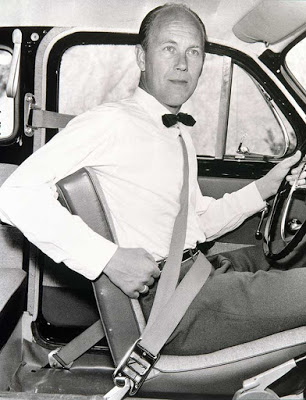
 Statistics from the National Transportation Safety Board (NTSB) show that 84 percent of all Americans use their seat belts. This is up from 58 percent in 1994. According to the NTSB, wearing a seat belt is the single most important thing you can do to improve your odds of surviving an accident. It wasn’t always that way, though. In fact, it wasn’t until the 1950s that seat belts were even an option. With some help from York of Crawfordsville, IN, a Chrysler, Dodge, Jeep, Ram dealer, we
have the complete story of this lifesaving device.
From the early 1900s until 1950s, little attention was paid to automotive safety. In fact, safety equipment was usually a “feature” that was added to a car to increase sales. Take a look at the inside of the cars of the 1950s, for example, and you’ll be amazed at what you see. Style was king so interiors were filled with hard, shiny surfaces and pointed objects. And yet no seat belts. It’s no coincidence that the fatality rate in car accidents was significantly higher than it is now. Americans may have been slow to develop seat belts but Scandinavia one car manufacturer took it very seriously.
Nils Bohlin was convinced that seat belts needed to be in cars. He was a Swedish engineer who had designed safety gear for Saab airplanes before joining Volvo in 1958. Even back then, safety was not only part of Volvo’s DNA but also a major component of its marketing strategy. When Bohlin joined Volvo, he was put in charge of their safety engineering group and he established that the design a new seat belt was the new top priority.
In aircraft, a four-point harness – two lap belts and two shoulder belts – was standard. But as Bohlin stated: “The pilots I worked with in the aerospace industry were willing to put on almost anything to keep them safe in case of a crash, but regular people in cars don’t want to be uncomfortable even for a minute.” So he started working on a design that people would find comfortable. “It was just a matter of finding a solution that was simple, effective and could be put on conveniently with one hand,” he explained.
Bohlin came up with the three-point seat belt, which ran across the chest and the lower torso with a single belt that buckled near the hip. Tests of this new harness proved it worked very well and it became standard equipment in all 1959 Volvos. equipment in every car sold in the United States. By the time Bohlin died in 2002, Volvo estimated that one million lives had been saved worldwide by his invention.
Federal statistics show that 84 percent of all Americans use their seat belts. This is up from 58 percent in 1994. According to the people who study this stuff, wearing a seat belt is the single most important thing you can do to improve your chances of surviving an accident. In fact, the one out of eight Americans who don’t wear their seat belts account for nearly two-thirds of all the fatal accidents, which suggests that getting killed is the penalty you pay for being a complete ignoramus.