
 Most people know that automobiles come with two basic transmission types. There are manual transmissions where the driver changes gears using a stick shift and there are automatics which do all of the shifting work using a torque convertor and sets of planetary gears. In general terms, cars with manual transmissions are a bit more efficient than automatics and get better gas mileage. What many people don’t know is that there is a transmission that offers the best of both worlds to drivers.
Whats Inside
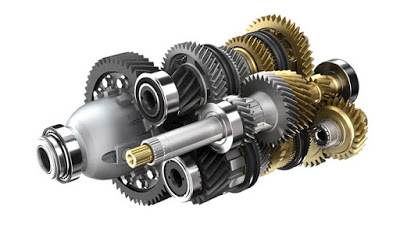
The insides of a dual-clutch transmission are functionally similar to good, old manual transmissions except for one key fact – they have two gear sets (!) To understand how this works, it’s helpful to review how manual gearboxes work.
When the driver of a manual transmission car changes from one gear to another, they first push down the clutch pedal. This operates the vehicle’s clutch assembly, which disconnects the engine from the gearbox and interrupts power flow to the transmission. Then the driver uses the stick shift to select a new “gear”. Once the new gear is engaged, the driver releases the clutch pedal, which re-connects the engine to the gearbox and transmits power to the wheels.
How DCTs Work
A dual-clutch gearbox, by contrast, uses two clutches, but has no clutch pedal. The way it works is that sophisticated electronics and hydraulics control the clutches, just as they do in a standard automatic transmission. In a DCT, however, the clutches operate independently of each other. One clutch controls the odd gears (first, third, fifth and reverse), while the other controls the even gears (second, fourth and sixth). Using this arrangement, gears can be changed almost instantly without interrupting the power flow from the engine to the transmission.
Some explain that a DCT is an “automated manual transmission.” This isn’t a bad description because there isn’t a power wasting torque convertor inside, like automatics have. In principle, the DCT behaves just like a standard manual transmission: It’s got input and auxiliary shafts to house gears, synchronizers and a clutch. What it doesn’t have is a clutch pedal, because computers, solenoids and hydraulics do the actual shifting. Even without a clutch pedal, the driver can still “tell” the computer when to take action through paddles, buttons or a gearshift.
Are They Better?
From many perspectives they are better. Perhaps the most compelling advantage of a DCT is improved fuel economy. Because power flow from the engine to the transmission is not interrupted by a torque convertor, fuel efficiency increases dramatically. Some experts say that a six-speed DCT can deliver up to a 10 percent increase in relative fuel efficiency when compared to a conventional five-speed automatic. This is a significant increase in gas mileage.
The folks at Zieglarchryslerdodge.com tell us that many car manufacturers are interested in DCT technology but adoption hasn’t been rapid so far. The reason is that that some automakers are wary of the additional costs associated with modifying production lines just yet to accommodate a new type of transmission. As with any new technology, it may take several years before DCTs become a major transmission option.
Source: Ziegler Chrysler Dodge