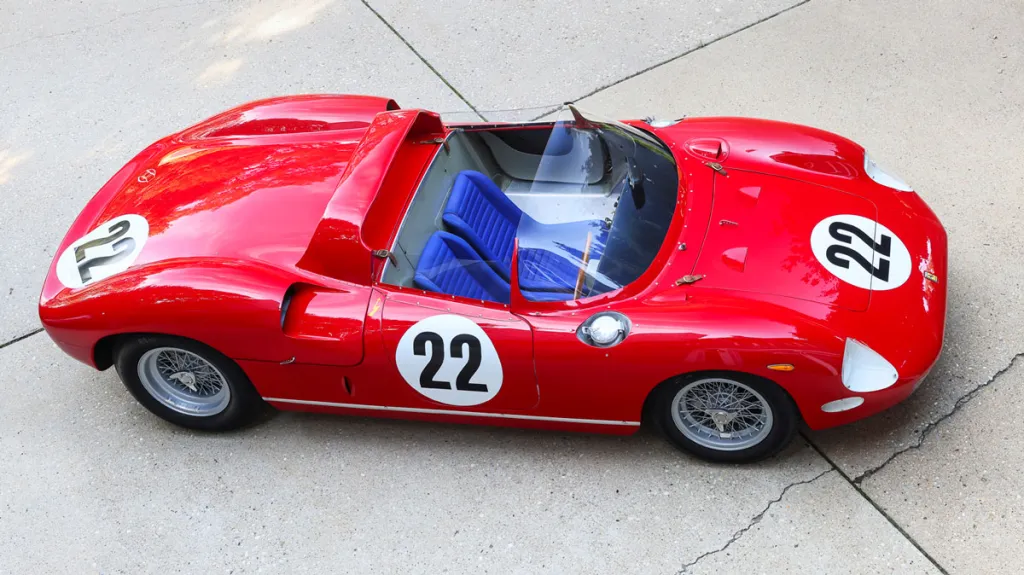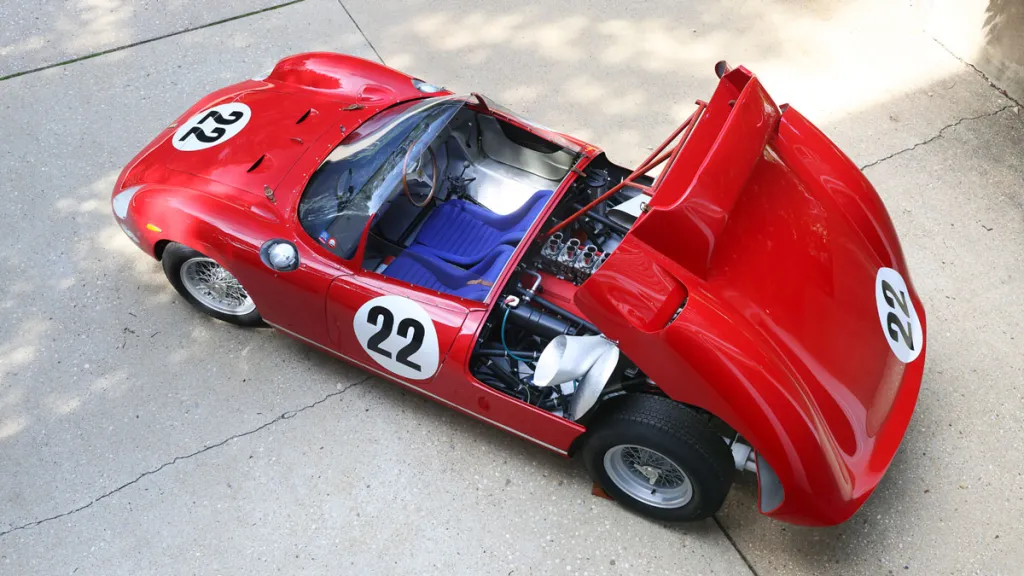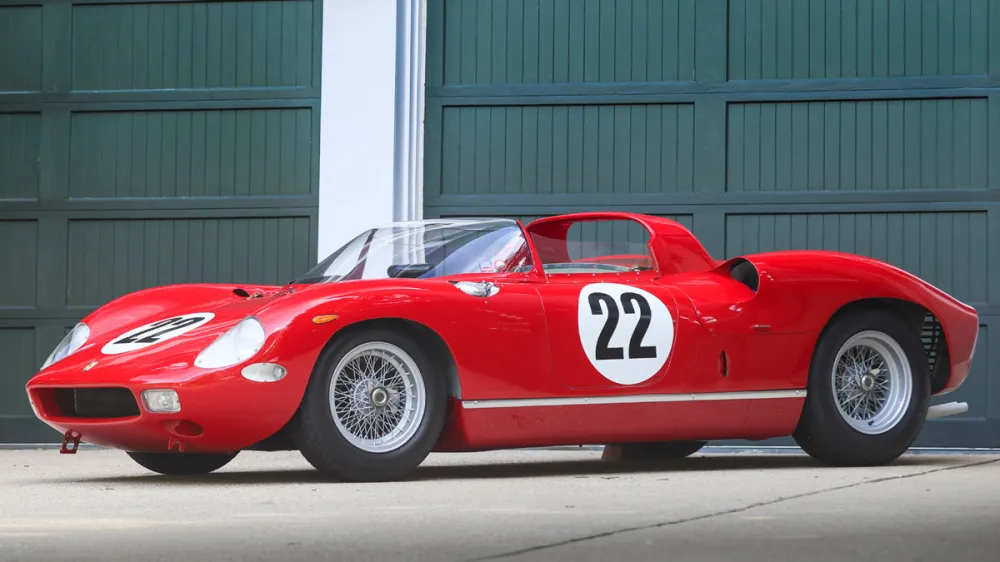
Few competition cars have influenced Ferrari’s future quite like the 1963 Ferrari 250 P. It marked a major turning point for the Italian marque, becoming the first Ferrari sports prototype to adopt a mid-engine layout instead of the traditional front-mounted V12 configuration.
That engineering shift transformed Ferrari’s racing programme and laid the foundation for decades of successful race and road cars that followed.
The significance of chassis 0810 is difficult to overstate. In its debut season as part of the factory Scuderia Ferrari team, it secured second place at the 1963 12 Hours of Sebring before finishing third overall at the legendary 24 Hours of Le Mans.
A Successful Career in North America
The following year, chassis 0810 crossed the Atlantic to join Luigi Chinetti’s famed North American Racing Team (N.A.R.T.), representing Ferrari in the United States.
Its American debut proved equally impressive. Driven by Mexican racing icon Pedro Rodriguez, the 250 P finished second overall at the Bridgehampton Double 500 before Rodriguez steered it to victory at the Canadian Grand Prix just weeks later.
Now, more than six decades after rewriting Ferrari’s racing philosophy, this historic machine will cross the auction block at Gooding Christie’s prestigious Pebble Beach sale on 15 August during Monterey Car Week.
The auction house expects the Ferrari to sell for between $15 million (approximately R250 million) and $20 million (approximately R335 million).
The Mid-Engine Ferrari That Defied Tradition
During the 1950s, Ferrari dominated endurance racing with front-engined legends such as the 250 Testa Rossa, 290 MM and 315 S. Enzo Ferrari remained convinced that this was the correct formula, even after the company’s Formula 1 cars had adopted mid-mounted engines.
Chief engineer Mauro Forghieri saw things differently.
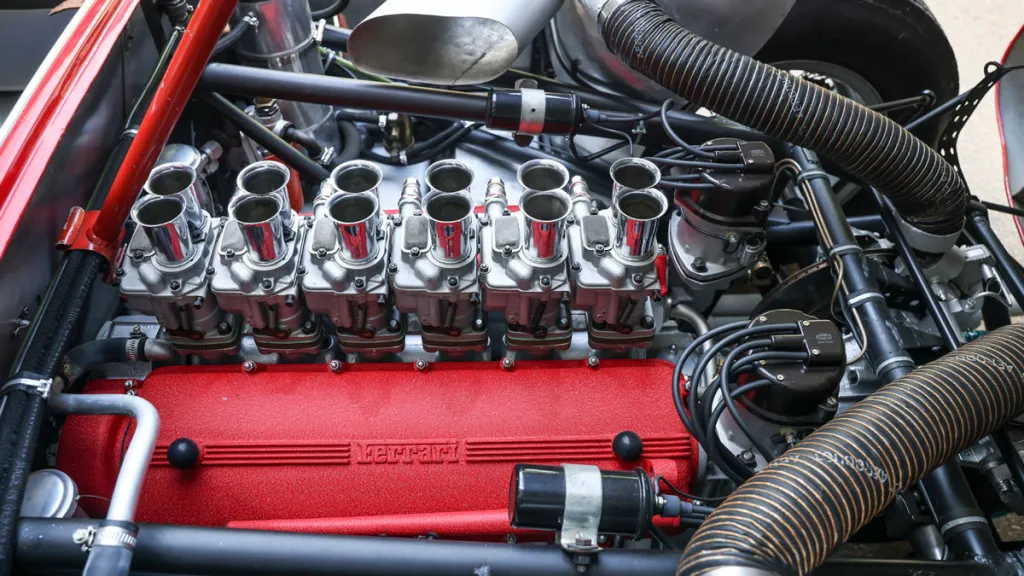
Working closely with World Champion John Surtees, Forghieri developed the revolutionary 250 P around a lightweight tubular chassis. Power came from a longitudinally mounted 3.0-litre Testa Rossa-derived V12 paired with a rear-mounted transaxle. The car also featured fully independent suspension and inboard rear disc brakes, making it one of Ferrari’s most technically advanced racing cars of its era.
Its elegant bodywork was penned by Pininfarina before being hand-crafted in aluminium by Carrozzeria Fantuzzi. Extensive wind tunnel testing helped refine its distinctive aerodynamic profile, including its low wraparound windscreen and unique cockpit fairing.
An Immediate Winner
Chassis 0810 made its public debut at Monza on 4 March 1963.
Just weeks later, Ferrari entered two examples in the opening round of the FIA World Sportscar Championship at Sebring.
While the sister car, chassis 0812, driven by John Surtees and Ludovico Scarfiotti, claimed victory, chassis 0810 finished an impressive second in the hands of Lorenzo Bandini, Nino Vaccarella and Willy Mairesse.
A one-two finish on the model’s debut instantly validated Ferrari’s bold move to a mid-engine configuration.
Constantly Evolving
Throughout the 1964 racing season with N.A.R.T., the car continued receiving factory upgrades.
Its original 3.0-litre V12 was first enlarged to 3.3 litres before eventually growing to a 4.0-litre specification.
At the end of the season, Luigi Chinetti sold the Ferrari to Pittsburgh industrialist William McKelvy, whose Scuderia Bear team campaigned the car at circuits including Lime Rock, Bridgehampton and Sebring.
Remarkably, McKelvy advertised the Ferrari for sale in 1966 for just $12,000 (approximately R202,000), highlighting how yesterday’s factory race cars were once viewed simply as used competition machinery rather than priceless collector’s items.
A Coveted Ferrari Collector’s Piece
The Ferrari later passed to Maryland racer and dealer Gordon Tatum, who repainted it dark blue to match his 250 GTO before racing it extensively in SCCA competition.
Following ownership by several respected Ferrari collectors, the car was acquired in 1987 by renowned Ferrari racer, collector and former dealer Harley Cluxton III.
After a comprehensive restoration, Cluxton sold the 250 P in 1988 to current owner Anthony Wang for a reported $3 million (approximately R50.5 million).
Wang, one of the world’s foremost Ferrari collectors, is known not only for preserving his cars but actively driving them. He famously exercised the 250 P at the 2024 Monterey Historics, demonstrating that this priceless racer remains exactly where it belongs: on the circuit.
With factory provenance, significant race history and an unmatched place in Ferrari’s engineering evolution, chassis 0810 is widely regarded as one of the most important Ferraris ever to reach the auction market.