
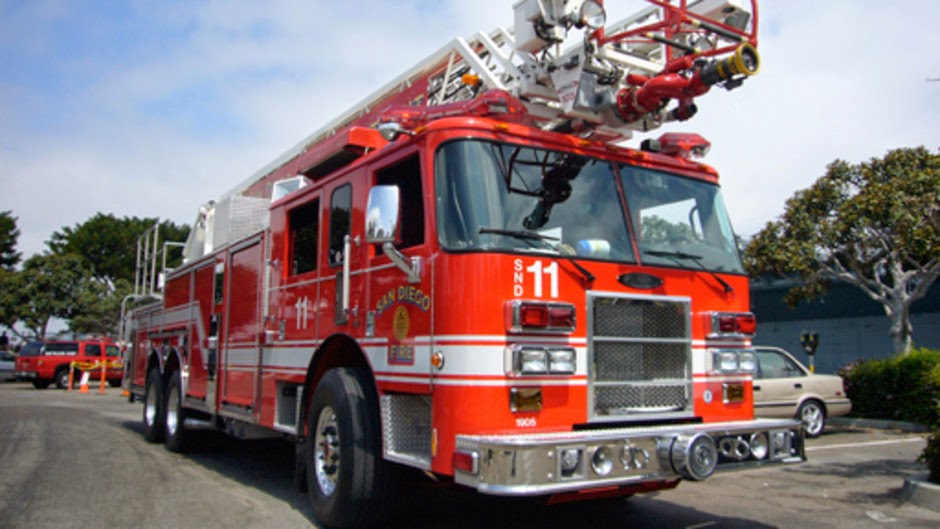
 When most people think about fire trucks or fire engines, the same kind of image comes to mind – the common red fire engines with blaring horns, roof-mounted lights, and hoses that can be seen in cities and towns across the nation on any given day. While such trucks are used in countless communities in the United States, thanks to their effective and reliable designs, those standard engines are in no way the only type of fire apparatus available. The unique demands of certain settings and certain types of fires require vastly different equipment, so even the all-too-familiar red engine can’t be used for the approximately 400,000 fires that burn in the U.S. each year.
Conventional Fire Truck
The fire truck that springs to the front of most people’s minds – the conventional fire truck – is an effective but largely no-frills model that balances storage space with speed, and maneuverability with utility. Such trucks are designed to move quickly through rural, urban, and suburban settings. This requires superior maneuverability compared to some other models, but typically they don’t need the heavy-duty shocks or highly reinforced body construction that trucks in wilderness settings tend to require. Special equipment tends to be limited, with a significant portion of space dedicated to hoses, fire fighters, and their equipment.
Aerial (Ladder) Trucks
Ladder trucks share many traits with conventional fire trucks, although they are a bit more specialized. Such trucks tend to be common in urban settings, where turntable-mounted, telescopic ladders can be used to reach tall buildings. The hydraulic-powered or pneumatic-powered ladders are usually mounted either directly behind the cab or further back on the truck chassis. These trucks may have special generating units on board to supply sufficient power for rotating and extending ladders.
Wildfire Trucks
Wildfire trucks, also known as brush trucks, are normally smaller and lighter than standard trucks in order to handle tougher terrain. Additionally, these trucks will typically have four-wheel drive so that fire fighters are not prevented from doing their jobs due to geographic conditions. Such trucks may also have the ability to pump water while moving rather than just while stationary in order to counter fast-moving or large brush fires. These trucks may also carry longer lengths of hose for tough-to-reach fires and specialized equipment in order to meet the unique challenges of the wilderness. You can see these and other types of used fire trucks at http://www.firetrucksunlimited.com/.
Command Support Units
Command support units are not fire trucks in the traditional sense, as they do not usually have any hoses, ladders or other types of equipment that come standard on fire engines reserved for fighting fires. Instead, these trucks are used to coordinate communications around and outside of the site of major fire incidents and other catastrophes. These units allow for the use of radio frequencies, satellite links, closed circuit television, and other communications devices. In addition to offering a communications hub, these command units provide a location for planning, mapping, and coordinating between different personnel when multiple crews are on the same site.