
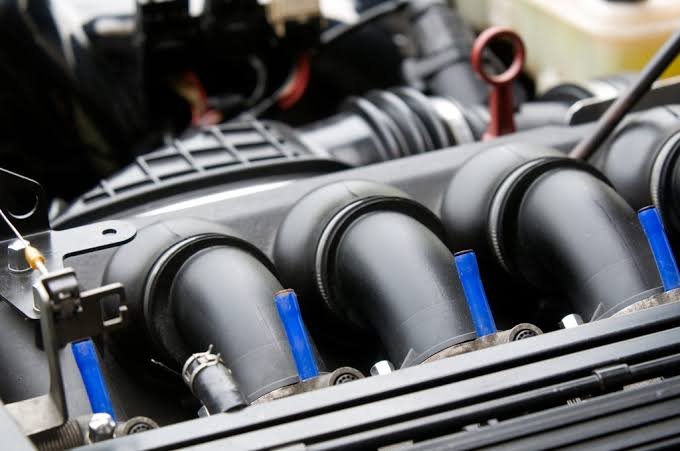
When a car develops hesitation, rough running or an unfamiliar mechanical noise, attention often turns to the engine, turbocharger or fuel system. Yet some performance complaints originate in the intake manifold. Modern manifolds may contain variable-length runners, swirl or tumble flaps, vacuum mechanisms, linkages, diaphragms and electronic actuators. Wear in one of these parts can alter airflow and affect engine response. In such cases, an intake manifold repair kit can address the worn mechanism without replacing the entire assembly, provided the main housing remains in good condition. Careful diagnosis is therefore more useful than replacing a large assembly based on symptoms alone.
Symptoms that can be mistaken for a bigger engine problem
A failing intake-manifold mechanism can cause hesitation during acceleration, rough idle or an intermittent rattle. A loose linkage or flap may vibrate only at certain engine speeds, while an actuator that moves inconsistently can make the engine behave normally one moment and poorly the next.
Diagnostic equipment can provide useful clues, but fault codes still require interpretation. A code related to airflow, runner position or actuator operation confirms an abnormal system state without necessarily identifying the failed mechanical part.
Other possible causes should also be considered:
- Vacuum or boost leaks elsewhere in the intake system.
- Faulty airflow, pressure or position sensors.
- Ignition problems involving plugs or coils.
- Fuel-delivery or mixture-control issues.
- Throttle-body or engine-management faults.
The symptoms should be assessed as a pattern. An actuator-position fault combined with visible linkage wear is stronger evidence than generic hesitation alone.
Diagnose the mechanism before replacing the manifold
Inspection should begin with the components that move or seal. Check the linkage for excessive play, paying particular attention to bushings and pivot points. Even small clearances can become significant after repeated operation.
Vacuum-operated systems require inspection of diaphragms, hoses and connections. Electronic actuators should be checked for correct movement and response rather than assumed to be defective because a fault code appears. The manifold body should also be inspected for cracks, damaged mounting areas and air leaks.
A practical inspection should cover:
- Flaps, rods, pivots and bushings for wear.
- Vacuum hoses, diaphragms and connections.
- Actuator travel and mechanism movement.
- Gaskets and sealing surfaces.
- Broken, loose or missing internal hardware.
Where diagnostic equipment is available, electronic findings should be compared with physical observations. A runner-position fault combined with obvious linkage play provides much stronger evidence than a fault code alone.
When an intake manifold repair kit is enough
A targeted repair makes sense when the manifold body remains sound and the problem is limited to serviceable hardware. If a runner flap is intact but its linkage or bushing has excessive play, replacing the worn part may restore proper movement. The same approach can apply to some vacuum components, seals and actuator parts.
An intake manifold repair kit can be suitable when it matches the manifold design and damaged mechanism. Repair is reasonable when:
- The manifold housing is intact.
- Moving flaps are not badly damaged.
- Wear is limited to replaceable parts.
- Actuator and control systems still work.
- Sealing surfaces remain reliable.
A complete replacement may be necessary if the manifold is cracked, severely damaged, has distorted mounting surfaces or extensive internal breakage. Any broken internal piece must also be accounted for before the engine returns to service, since a loose fragment in the intake system can cause further damage.
The goal is not to avoid replacement at any cost. It is to avoid replacing a complete assembly when the failure is limited to a component that can be safely and correctly repaired.
Match the repair to the engine and manifold version
Intake manifold components are highly application-specific. Two engines may use similar-looking mechanisms with different flap dimensions, linkage geometry, actuator arrangements or sealing details. Differences can also exist between engine families and production revisions from the same manufacturer.
Model and year alone may therefore be insufficient for accurate identification. The original manifold should be matched against reliable application data before ordering a component. Engine code, exact vehicle application, OEM part number, mechanism type and the physical configuration of the original part are especially useful.
The OEM reference becomes particularly important when several revisions exist. If the manifold was previously replaced, its current part number may be more relevant than the number originally associated with the vehicle.