
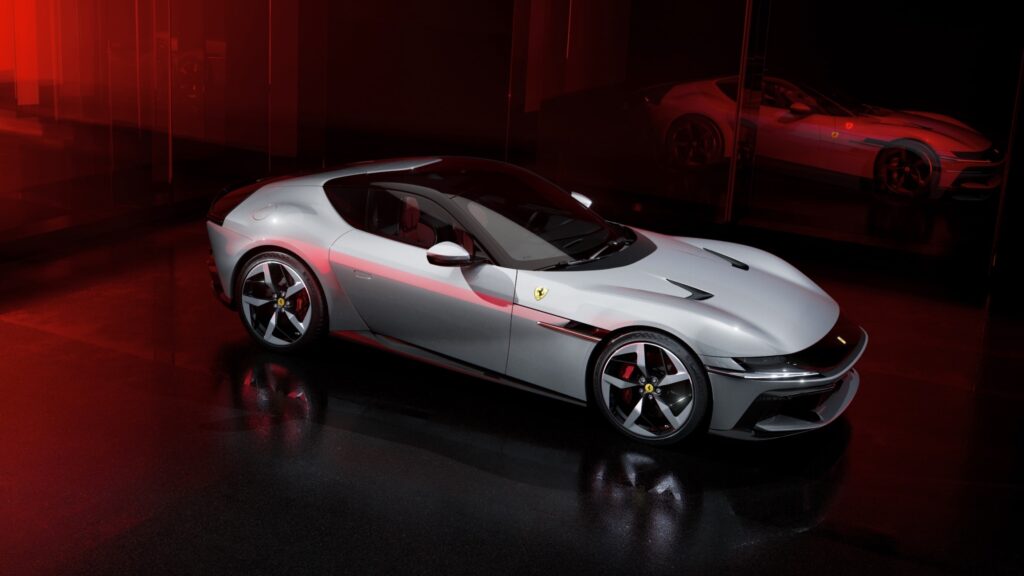
Ferrari has had a busy few weeks at the trademark office. Hot on the heels of registering the F80 XX and 12Cilindri GTO names, Maranello looks set to drop another surprise, and this one might be the most intriguing yet. Industry chatter points to a reveal on 4 July 2026 for a car expected to wear the 12Cilindri MM badge, a limited-run variant built around a transmission interface unlike anything currently in Ferrari’s range.
A Trademark Trail That’s Hard to Ignore
Trademark filings rarely tell the whole story, but when they arrive in a cluster like this, they’re worth paying attention to. Following the F80 XX and 12Cilindri GTO registrations, the MM filing fits a pattern Ferrari watchers know well: a flurry of paperwork usually precedes a proper unveiling. With the timing lining up so neatly, it’s looking increasingly likely that Maranello has something special queued up for the middle of next month.
What Ferrari’s CEO Let Slip in Las Vegas
Speaking to dealers at a recent conference in Las Vegas, Ferrari boss Benedetto Vigna teased that the brand had a fresh reveal on the way, one he described as blending something rooted in the past with a clear eye on where the brand is headed next. He stopped short of confirming any details, but the timing of his comments, paired with the trademark activity, has fuelled speculation that the 12Cilindri MM is exactly what he was referring to.
The Patent That Gives the Game Away
A recently published design patent, listed as US 2026/0160329 A1, may have already revealed Ferrari’s hand. It depicts a ball-topped shifter housed in a slotted gate numbered one through six, with reverse handled separately rather than built into the gate itself. Flanking the shifter are buttons for manual, drive, neutral, and reverse modes.
What’s happening beneath that metal gate plate is the clever part. The mechanism is engineered to replicate the resistance and feel of a traditional manual shift action, even though the actual gearbox doing the work is almost certainly the same dual-clutch unit, supplied by Magna, found in the standard 12Cilindri. The system’s software is also said to restrict access to certain gates at higher speeds, a detail that suggests Ferrari’s engineers went to genuine lengths to make the experience feel authentic rather than gimmicky.
Why a 4 July Reveal Makes Sense
Independence Day in the United States isn’t a date Ferrari has picked at random. It also happens to fall on the same weekend as qualifying for the British Grand Prix, where Charles Leclerc and Lewis Hamilton will be flying the Scuderia’s flag at Silverstone. Unveiling a halo road car on the same day the Formula 1 team is in the spotlight would be a typically savvy piece of timing from Maranello’s marketing department.
Where the MM Name Comes From
The “MM” designation isn’t a random pairing of letters. It’s a direct nod to the Mille Miglia, the legendary open-road endurance race through Italy that shaped much of Ferrari’s early racing identity. The brand has used the MM suffix before, most notably on the 250 MM and 340 MM, with roots tracing back further still to the 166 MM. Reviving the badge for a modern V12 grand tourer would tie the new car neatly into that racing lineage.
A System With Echoes of Koenigsegg
Ferrari isn’t the first manufacturer to chase this kind of driver engagement through clever engineering rather than a traditional clutch and gearbox. Koenigsegg’s Engage Shift System achieves something similar, letting drivers toggle between a fully automatic mode and a simulated gated manual experience. Underneath, the Swedish hypercar still relies on a nine-speed automatic transmission, but both the shifter and clutch pedal operate via shift-by-wire, sending electronic signals to a control unit rather than physically engaging components.
That same shift-by-wire principle appears to underpin Ferrari’s patent. Instead of mechanical linkages, the pedal and lever communicate digitally with the car’s brain, which then decides how to translate driver inputs into shifts. It’s a software-driven approach to recreating an analogue feeling, and one that’s becoming increasingly common as manufacturers look for ways to keep manual-style engagement alive in an automatic-dominated era.
Manual Feel, No Clutch Pedal in Sight
There’s one notable omission from Ferrari’s patent filing: any mention of an actual clutch pedal. Like Koenigsegg’s approach, this looks set to be about recreating the sensation and ritual of rowing through gears rather than offering a true three-pedal manual. Whether purists will accept that trade-off remains to be seen, but if the 12Cilindri MM does land on 4 July as expected, it could mark one of the more interesting attempts yet to keep the spirit of manual driving alive in a dual-clutch world.